
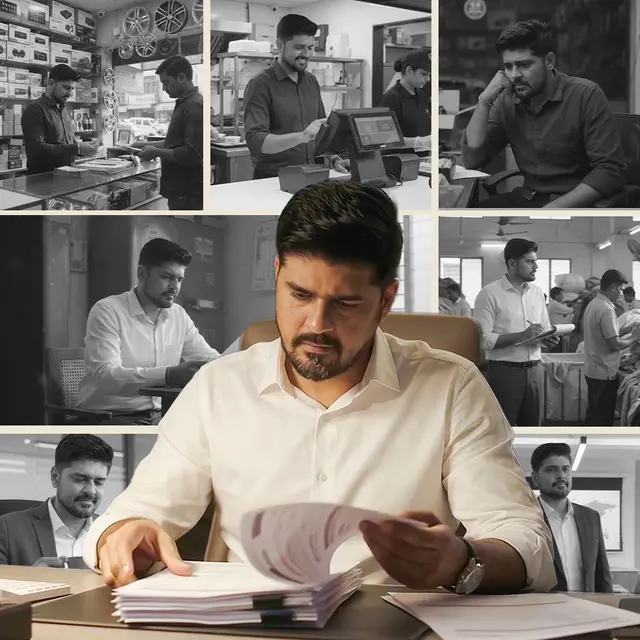
Most founders believe scaling is a question of ambition, effort or capital. Our founder learned otherwise by losing two businesses, one almost overnight and one month by month. This is the reason why businesses fail to scale and it is rarely the thing founders expect.
He started his first business at eighteen. He built his second one properly, with a consultant, a central kitchen and five outlets inside eighteen months. Both are gone. What he carried out of those two losses, and later proved at a 500 outlet salon chain, is the single idea behind every franchise readiness audit we run today.
Not sure what is holding your expansion back?
Most founders spend years fixing the wrong problem. Eleven questions show you yours.
Why Businesses Fail to Scale Is Rarely About Effort
Ask a founder why growth stalled and you usually hear about funding, competition or timing. In practice, the businesses that fail to scale break on something quieter. One business could not survive without its owner in the room. Another grew five outlets while losing money on every one of them. A third had 500 outlets and a brand customers loved, and still could not convert the people who wanted to invest in it.
Three different businesses, three different failures, and not one of them was caused by a lack of hard work. That pattern is the reason the franchise readiness audit exists. Every problem below could have been caught early if someone had asked the right questions first.
Watch the Founder Story
Runtime 6 minutes 32 seconds. The full story is written out below if you would rather read it.
The Founder Story in His Own Words
In his own words
I have lost two businesses in my life. One was gone almost overnight. The other, I watched it fall apart month by month. Both experiences taught me lessons I could never have learned in a business school. And today I want to share those lessons with you so you do not have to make the same mistakes I did.
I was just 18 when I started my first business, car accessories. The first 18 months were tough. That was my real school. I learned every part of a business there, buying, selling, finance, managing technicians, leading a team. And slowly it started working. Customers came in, sales picked up, people started respecting what I had built.
But there was one problem. The business could not run without me. Purchasing, me. Sales, me. Operations, finance, every single decision came back to me.
I was not running the business. I was the business.
And a business that depends on one person can only grow as big as that one person. So I could not open a second store because there was no second me.
I missed family functions. I missed weekends. Without me even noticing, the business had taken over my life.
And then one day the property was bought by the Taj Group. Just like that, everything I had built was gone.
Sitting with that loss, I made myself one promise. The next business I build will never depend only on me.
So this time I did everything differently. I started a QSR brand in food and beverage. I hired a consultant. I invested in a central kitchen. And we opened five outlets in just 18 months. For the first time I had a team. I had systems. I had a business that did not need me at every counter. On paper it was the dream.
But something was not adding up. Every month more money was going out than coming in. And I could not figure out why.
The answer was shelf life. Our products did not last long enough. Whatever we could not sell we threw away. And every new outlet we opened made that leak bigger. We were growing, but we were bleeding.
That is when I understood something I have never forgotten.
Growth does not fix a broken business model. It multiplies it.
After two years, I shut it down. I had lost all my capital and I was in debt.
Two businesses, two very different lessons. This time I promised myself I would not jump at the next opportunity that came my way. I decided to stop and learn how scaling actually works.
It was 2010. A startup wanted to build an organised laundry brand. Back then, laundry in India was almost entirely unorganised. Small, family run shops doing things the traditional way. I did my research and I saw a huge opportunity.
Now, as an entrepreneur, working as an employee did not come easy to me, but I had no capital left to invest. So when they offered me ESOPs, a real stake in what we were building, I said yes.
And for the first time, my role was clearly defined. I had one job, business expansion. In three years, we grew to more than 40 outlets across the southern states. That is where I discovered franchising and saw how the right systems let a business grow far beyond its founder. I played my role well and honestly, I enjoyed every bit of that journey.
Then came my next big chapter, Naturals. A loved brand, a chain of 500 outlets. Customers trusted it, investors wanted it. And yet, it was struggling to grow. Not because the brand was weak, but because there was no proper structure to capture the people who wanted to invest in it. Inquiries were coming in, but there was no system to capture them, follow them up, and convert them into partners. Opportunities were slipping through the cracks.
So I started where every scalable business has to start, with the foundation. I built my team, I built the digital infrastructure to capture and track every lead. I put a process behind every step from first inquiry to partner. And then the growth came. 186 outlets signed in 28 months. And we took the brand beyond India into international markets.
That is when it really clicked for me. Even a great brand cannot scale on reputation alone.
Growth needs a structure ready to receive it.
After Naturals, I wanted to go deeper, not just scale one brand, but understand what it takes for any business to scale across India and across the world. That is when the next opportunity came, a franchising company with a presence across India and 35 countries. I was offered the opportunity to head the division, working alongside a colleague with deep franchising experience. We started with a team of four. Over five years, I built it to 56 and together we helped businesses expand across India and into international markets.
Those five years showed me again and again what separates businesses that scale from businesses that struggle. It is not ambition. It is not hard work. Most founders have plenty of both. It is having the right systems in place before you grow.
Looking back, I realised something. My first business had a dependency problem. My second had a numbers problem. And even a brand as strong as Naturals was held back until the right structure was in place. Every one of these problems could have been caught early if someone had asked me the right questions before I invested.
That is why I built the franchise readiness audit at Corporate Culture. It checks your business on the seven things that decide whether it can grow without you. Unit economics, operational repeatability, support infrastructure, founder and leadership, market readiness, brand positioning, and partner profile, plus a legal and trademark check.
Start with the free audit. Just 11 questions and you will see where you stand and which area is holding you back.
Want a deeper diagnosis? The franchise readiness report gives you your exact score and ranks your gaps by what they are really costing you. The 90 day franchise road map shows you what to fix first, what comes next, and how to move forward step by step.
Because the goal is not just to open more outlets, it is to build a business that grows without everything depending on you.
I learned these lessons the hard way. I lost a business I loved. I lost my capital. You do not have to.
Before you invest in expansion or sell your first franchise, find out if your business is truly ready. Take the free franchise readiness audit by Corporate Culture. Your next outlet will thank you.
FOUNDER NAME, Founder, Corporate Culture
Three Businesses and Three Different Failures
Read the story again and a pattern shows up. The businesses did not fail for the same reason, which is exactly why generic advice does not help founders. A dependency problem and a unit economics problem need opposite fixes, and treating one like the other wastes years.
Car accessories
What broke
Founder dependency
How it looked from outside
Profitable and respected, but could never open a second store.
QSR food brand
What broke
Unit economics, driven by product shelf life
How it looked from outside
Fast growth and a real team, while every new outlet widened the loss.
Naturals
What broke
No structure to capture and convert investor interest
How it looked from outside
A brand customers trusted and investors wanted, stuck anyway.
Founder Dependency Is the First Ceiling Every Business Hits
The first business was profitable. Customers came back, sales grew, and people respected what had been built. None of that mattered, because every decision still routed through one person. Purchasing, sales, operations and finance all ended at the same desk.
A business like that has a hard ceiling, and the ceiling is the owner. There was no second store because there was no second owner to run it. This is the most common reason businesses fail to scale in India, and it is almost always invisible from the outside, because the numbers look fine right up to the moment growth is attempted. We have written separately about how to scale a business without founder dependency if you recognise your own company in this.
The loss itself came from outside. The property was bought by the Taj Group and the business ended with it. But the reason it could not be rebuilt elsewhere, or had not already grown into something bigger, was the dependency that had been there all along.
Growth Multiplies a Broken Business Model
The second business was the corrected version. A consultant was hired. A central kitchen was built. A team was in place and the founder was not standing at every counter. Five outlets opened in eighteen months, which most people would call a success story.
The model underneath was losing money, and nobody had checked. The products did not last long enough on the shelf, so unsold stock was thrown away every day. One outlet can absorb that kind of leak quietly. Five outlets cannot. Each new location did not spread the cost, it copied the loss.
This is the trap that catches good operators. Systems and a team fix a dependency problem. They do nothing at all for a unit economics problem. If the single outlet does not make money after every real cost, opening more outlets only increases the speed at which capital disappears.
Two years later it closed, with the capital gone and debt on top. The lesson is the line from the video, and it is worth sitting with before any expansion decision. Growth does not fix a broken business model. It multiplies it.
A Strong Brand Still Needs Structure to Grow
Naturals is the part of the story that surprises people. This was not a weak business. It was a chain of 500 outlets with customers who trusted it and investors who wanted in. By its twentieth year the chain had reached close to 650 salons in India and overseas, and co-founder Veena Kumaravel credited the franchise model’s success to the company’s centralised training facility outside Chennai, which is to say the systems rather than the name. (The Hindu)
Even so, growth had stalled. Enquiries were arriving and then going nowhere, because there was no system to capture them, follow them up and turn them into signed partners. The demand existed. The machinery to receive it did not.
The fix was unglamorous. A team, digital infrastructure to track every lead, and a defined process from first enquiry through to signed partner. What followed was 186 outlets signed in 28 months and the brand’s first move into international markets. We have broken that work down in detail in how we closed 180+ beauty franchise deals.
That is the third failure mode, and the one most brands with real traction are sitting in right now. Reputation brings people to your door. It does not sign them.
The Seven Checks Inside the Franchise Readiness Audit
The Seven Checks Inside the Franchise Readiness Audit
Every one of those three problems was findable in advance. None of them was found, because nobody asked the right questions before the money went in. That is the whole reason the franchise readiness audit was built the way it was. It tests the seven things that decide whether a business can grow without its founder, plus a legal and trademark check.
1
Unit economics
Does one outlet make money after every real cost. This is the check the QSR brand never ran.
2
Operational repeatability
Can someone else run it to the same standard without you in the room.
3
Support infrastructure
Training, supply and the back end a partner needs once they sign.
4
Founder and leadership
How much of the business still lives in one person’s head. The first ceiling.
5
Market readiness
Whether demand exists in the cities you want to enter, not only the one you know.
6
Brand positioning
Whether the brand means something specific enough for a partner to sell.
7
Partner profile
Knowing who the right franchisee is before you start signing the wrong ones.
PLUS
Legal and trademark
Whether you actually own the name you are about to license to other people.
The free version is 11 questions and shows you where you stand and which area is holding you back. If you want the detail, the franchise readiness report gives you an exact score and ranks your gaps by what each one is costing you, and the 90 day road map sets the order of the fixes. You can also work through our franchise readiness checklist first, or read the five signs a brand is ready to franchise.
Find out where your business actually stands
Eleven questions. No cost. You will see which of the seven areas is holding your expansion back before you spend a rupee on it.
Take the free franchise readiness auditWould you rather talk it through? WhatsApp us on +91 63819 37457
What This Means If You Are Planning to Scale
There is a version of this story where none of the losses happen. The car accessories business trains a second manager and opens a second store. The QSR brand runs the shelf life maths on one outlet and reformulates before opening four more. Naturals builds the enquiry process in year one instead of year fifteen.
What makes the difference is not talent and it is not capital. Most founders who fail to scale were working hard on the wrong problem, and nobody told them which problem was theirs. Two decades of expansion work, across a laundry chain, a salon network and businesses in India and abroad, keep returning to the same conclusion. The right systems have to be in place before the growth arrives, not after.
If you are weighing up expansion, the useful question is not whether your business is good. It probably is, or you would not be considering this. The question is which of the seven areas is weakest, and what that weakness will cost once you multiply it across ten locations. A franchise consultant earns their fee by finding that answer before your capital does.
Two businesses were lost learning this. You can get the same answer in eleven questions.
Frequently Asked Questions
Why do most businesses fail to scale?
Rarely for lack of effort or ambition. In practice it comes down to one of three things. The business depends too heavily on its founder, the single unit does not make money once every real cost is counted, or there is no structure to capture and convert the demand the brand already has. Each needs a different fix, which is why generic growth advice tends not to help.
What is founder dependency and why does it block growth?
Founder dependency means the important decisions and relationships still sit with one person. Purchasing, sales, hiring and finance all end at the same desk. The business can be profitable and well regarded and still be unable to open a second location, because there is nobody who can run it to the same standard. The ceiling on the business becomes the capacity of one individual.
Can a strong brand still fail to scale?
Yes, and it is common. Naturals had 500 outlets and no shortage of interested investors, and growth had still stalled because enquiries were not being captured or followed up. Once a team, lead tracking and a defined process from enquiry to signed partner were put in place, 186 outlets were signed in 28 months. Reputation brings people to the door. A process is what signs them.
What does a franchise readiness audit check?
Seven areas, plus a legal and trademark check. The seven are unit economics, operational repeatability, support infrastructure, founder and leadership, market readiness, brand positioning and partner profile. Together they answer one question, which is whether the business can grow without everything depending on the founder.
How long does the free franchise readiness audit take?
Eleven questions, and there is no cost. It tells you where you stand across the seven areas and which one is holding your expansion back. Most founders finish it in a few minutes.
What comes after the free audit?
Two things, if you want to go further. The franchise readiness report gives you an exact score and ranks your gaps by what each is actually costing you. The 90 day franchise road map then sets the order of work, what to fix first, what follows and how to move through it step by step.