
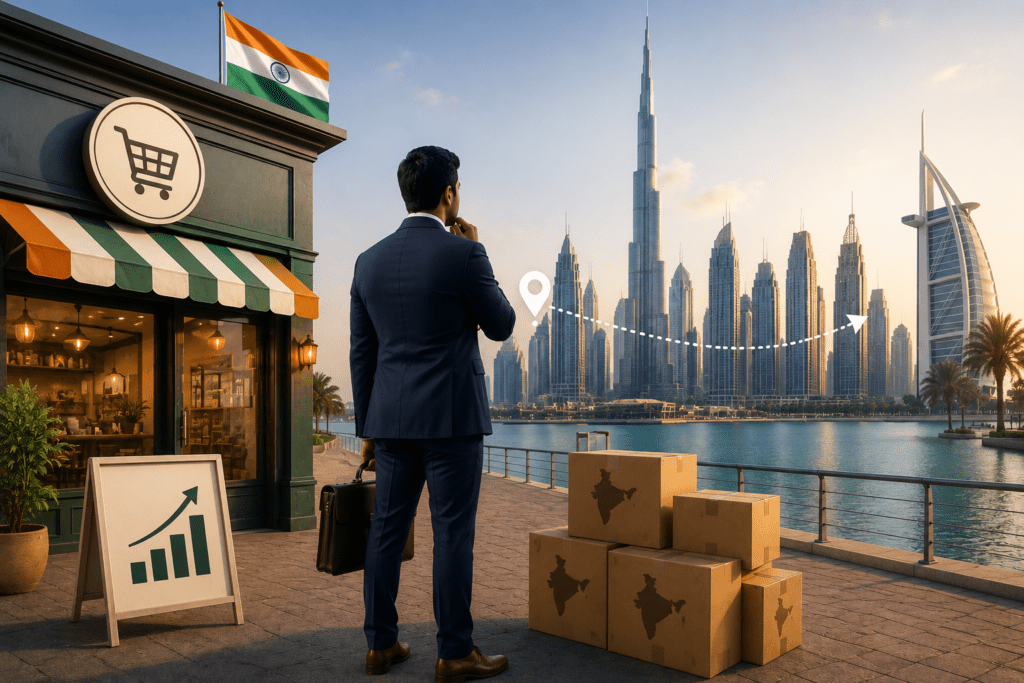
Dubai is the most common first international destination for Indian brands expanding to Dubai and the GCC — and it is also where most of them make the same three structural mistakes. The reasons for choosing Dubai are obvious. Geographic proximity. Approximately 3.5 million people of Indian origin living in the UAE. Strong cultural familiarity. A relatively straightforward regulatory path to entry. For Indian founders, Dubai feels less like a foreign market and more like an extension of India.
This is exactly why most Indian brands struggle when they get there. According to Apparel Resources, the GCC apparel market alone is projected to reach USD 35.78 billion by 2024 — and the broader retail opportunity is significant. But opportunity and readiness are not the same thing. The brands that capture the GCC opportunity are the ones that rebuild themselves for a global market. The brands that do not are the ones that copy-paste India and wonder why it did not work.
Why Dubai Feels Easy — And Why That Is the Problem
When founders evaluate Dubai, they typically see one number first — the size of the Indian population in the city. The math seems straightforward:
- 3.5 million people of Indian origin in the UAE
- A sizeable share concentrated in Dubai itself
- Familiar customers with familiar tastes and existing brand recall
- A cultural context that feels recognisable to an Indian founder
The assumption that follows is that replicating the Indian playbook will produce similar results. That assumption is wrong — and it is the root cause of most Indian brand failures in the Dubai market.
⚠ The GCC expansion myth
Dubai’s Indian population is not a smaller version of India’s middle class. It is wealthier, more globally exposed, and shaped by a retail environment that benchmarks against international standards — not Indian ones. The Indian customer in Dubai shops alongside Emiratis, Filipinos, British expatriates, and South Asians from across the diaspora. Their expectations are calibrated to Dubai’s broader market, not India’s.
Mistake 1 — Translating Indian Pricing Into AED Without Rethinking Value
The first and most common mistake Indian brands make when expanding to Dubai is converting Indian pricing directly into AED without rethinking the underlying value proposition. The arithmetic looks logical — take the Indian rupee price, apply the exchange rate, add import costs and operating overhead. The result is a price point that the founder assumes is competitive.
It rarely is — for two structural reasons.
The Affordable End Does Not Work
If the brand was positioned as accessible or value-driven in India, the AED-converted price point often lands in a segment where it competes directly against well-established, highly trusted international brands. The Dubai consumer at the affordable end of the market has no reason to choose an unfamiliar Indian brand over a McDonald’s, a Zara, or a Naturals-equivalent with international brand recognition.
The Premium End Does Not Work Either
If the brand was positioned as premium in India and the founder increases pricing to reflect Dubai’s higher operating costs — rent, staff, logistics — the price point often lands in a segment where the Dubai consumer is already choosing globally recognised luxury or near-luxury brands. An Indian brand asking premium Dubai prices without the international credibility to justify them faces a credibility gap from the first customer interaction.
What pricing strategy for Dubai actually requires:
- Independent research on what the Dubai consumer at your target segment actually pays for comparable products or experiences
- A clear articulation of why your brand deserves that price point in a market where you are unknown
- A value proposition that is built for the Dubai consumer — not translated from the Indian one
- Willingness to enter at a price point that builds trust first, then scales — rather than maximising margin from day one
Mistake 2 — Keeping the Indian Brand Aesthetic Unchanged
The second mistake is assuming that the visual identity, store design, packaging, and marketing aesthetic that worked in India will translate directly into a Dubai retail context. It will not — and the gap is more visible than most founders expect until they stand in a Dubai Mall corridor and look at their outlet next to the international brands around it.
Dubai’s retail standard is among the highest in the world. Over 90 new luxury fashion and beauty stores opened in 2024 across malls in Riyadh, Dubai, Doha, and Manama — with brands like Hermès, Dior, and Zimmermann entering or expanding. The visual context that Indian consumers are navigating in Phoenix Marketcity or Select Citywalk is materially different from the visual context Dubai consumers navigate in Mall of the Emirates or Dubai Mall. The comparison set is different. The benchmark is higher. And the gap between Indian retail aesthetics and Dubai retail aesthetics — even for strong Indian brands — is often significant.
What needs recalibration for the Dubai market:
- Storefront design — materials, lighting, and spatial layout benchmarked against Dubai’s premium retail standard, not India’s
- Packaging and product presentation — visual finish and quality perception must hold up against international competitors on the same shelf or in the same mall
- Photography and campaign creative — imagery created for Indian platforms with Indian models and Indian visual references will not resonate with Dubai’s multi-national consumer base
- Staff styling and service standards — the training, presentation, and customer interaction model must be recalibrated for a Dubai consumer who expects international service norms
A brand experience that feels premium in Bengaluru can feel basic in the Dubai Mall. The retail context is different. The benchmark is different. The visual recalibration is not optional — it is the entry requirement.
Mistake 3 — Building Only for the Indian Diaspora
The third mistake is the most strategically limiting. Brands that enter Dubai with the Indian diaspora as their only target customer cap their growth potential from day one. The Indian population in Dubai is large — but it is not the entire market. And the brands that succeed long-term in Dubai are not the ones that serve only Indian customers. They are the ones that build for a global customer who happens to include a strong Indian segment.
The distinction matters structurally for three reasons:
- The Indian diaspora customer in Dubai is already well-served — established Indian brands, Indian grocery chains, Indian restaurants, and Indian service providers have been in Dubai for decades. A new Indian entrant is competing with incumbents who already have loyalty and recognition
- Diaspora-only positioning limits real estate options — if the brand is only relevant to Indian consumers, it can only viably locate in catchments with high Indian population density, which limits mall placement, high-street options, and tourist-zone presence
- The broader Dubai market is significantly larger — Emiratis, British, American, Filipino, Pakistani, and European consumers all spend in Dubai’s retail market. A brand positioned for the global Dubai consumer with a strong Indian identity — rather than an exclusively Indian brand — accesses all of these segments simultaneously
💡 The right positioning frame for Dubai: Build for a global customer who happens to include a strong Indian segment — not the other way around. Junior Kuppanna’s international expansion into Malaysia, Colombo, and Dubai demonstrates this — the brand carries an authentic South Indian food identity that resonates deeply with the diaspora but is framed as a distinct culinary experience, not a diaspora-only proposition. That framing opens the brand to every curious food consumer in the market, not just Indian-origin visitors.
What Successful GCC Expansion Actually Requires
The GCC is a significant opportunity for Indian brands — particularly in food, beauty, retail, and lifestyle categories where Indian quality and authenticity carry genuine consumer appeal. The India Global Forum has launched a $250 million fund to support high-potential Indian consumer and industrial brands in expanding to global markets, positioning Dubai as the hub for their international growth. The capital and institutional support for Indian brand internationalisation is growing. But capital without structural readiness does not produce successful market entry. It produces a well-funded version of the same three mistakes.
Successful GCC expansion requires five structural decisions made before the market entry, not after the first quarter of poor performance:
- Independent market research — specific to your category, your price segment, and your target consumer in the Dubai context, not extrapolated from India
- Value proposition rebuild — not translation. What the brand stands for in Dubai must be defined specifically for that market and that consumer
- Aesthetic recalibration — store design, packaging, photography, and service standards benchmarked against Dubai’s retail environment, not India’s
- Partner selection rigour — a local partner with genuine market knowledge, operational capacity, and brand alignment. Not the first interested party
- Operating system readiness — the franchise or retail operating model must function without founder presence, in a different time zone, with a different team. If it cannot, the market entry will be founder-dependent from day one
Dubai is a different country with familiar faces — not an extension of the home market. Brands that copy-paste India fail. Brands that rebuild themselves for a global customer succeed. If your brand is evaluating expansion into the UAE, Saudi Arabia, or the wider GCC, the readiness conversation should happen before the market-entry decision. Corporate CultureFranchise Readiness Audit includes a market-readiness review tailored to your target geography — helping you identify the structural gaps before a new market exposes them.
Is your brand evaluating GCC expansion?
Corporate Culture works with Indian brands evaluating expansion into the UAE, Saudi Arabia, and the wider GCC — covering market-entry strategy, value proposition rebuild, partner selection, and operating system readiness before the first investment is committed.
Frequently Asked Questions
Why do Indian brands fail when expanding to Dubai?
Most Indian brands expanding to Dubai fail for three structural reasons — they translate Indian pricing into AED without rethinking the value proposition, they keep Indian brand aesthetics unchanged in a retail environment that benchmarks against international standards, and they build only for the Indian diaspora rather than for a broader global consumer. The underlying cause of all three is the assumption that Dubai is an extension of India. It is not. It is a different market with a familiar face — and the brands that treat it that way pay for it.
Is Dubai a good market for Indian brand expansion?
Yes — Dubai is a significant opportunity for Indian brands in food, beauty, retail, and lifestyle categories. The GCC apparel market alone is projected at USD 35.78 billion, and Dubai’s Indian population of approximately 3.5 million provides a strong cultural foundation for brand entry. However, opportunity and readiness are not the same thing. The brands that capture the Dubai opportunity are structurally prepared — with an independently validated value proposition, a recalibrated visual identity, and a partner who understands the local market.
What is the right pricing strategy for Indian brands entering Dubai?
The right pricing strategy starts with independent research on what Dubai consumers at your target segment actually pay for comparable products or experiences — not a conversion of Indian prices into AED. It requires a clearly articulated value proposition that justifies the price point for a consumer who does not know your brand. And it typically requires entering at a price point that builds trust first, then scales — rather than trying to maximise margin from day one in an unfamiliar market.
Should Indian brands in Dubai only target the Indian diaspora?
No — and brands that build only for the Indian diaspora cap their growth potential significantly. The Indian population in Dubai is large but already well-served by established Indian brand incumbents. The broader Dubai market — Emiratis, Europeans, Filipinos, South Asians from across the diaspora — is significantly larger and accessible to brands that position themselves as a global consumer experience with a strong Indian identity, rather than an exclusively Indian brand for Indian customers.
What does brand aesthetic recalibration mean for Indian brands entering Dubai?
Aesthetic recalibration means benchmarking your storefront design, packaging, photography, campaign creative, staff styling, and service standards against Dubai’s retail environment — not India’s. A brand experience that feels premium in an Indian mall can feel basic in a Dubai mall because the visual and service context is materially different. Recalibration is not about abandoning Indian identity. It is about presenting that identity at the visual and service standard that Dubai consumers expect.
How do I know if my brand is ready for GCC expansion?
Your brand is ready for GCC expansion when five conditions are met — you have independently validated your value proposition for the specific Dubai or GCC consumer, your operating system functions without founder presence, you have identified and evaluated local partners against a structured selection criteria, your unit economics have been stress-tested at GCC pricing and operating costs, and your brand aesthetic has been benchmarked against the target market’s retail standard. Corporate Culture’s Franchise Readiness Audit covers all five of these dimensions for brands evaluating international market entry.