
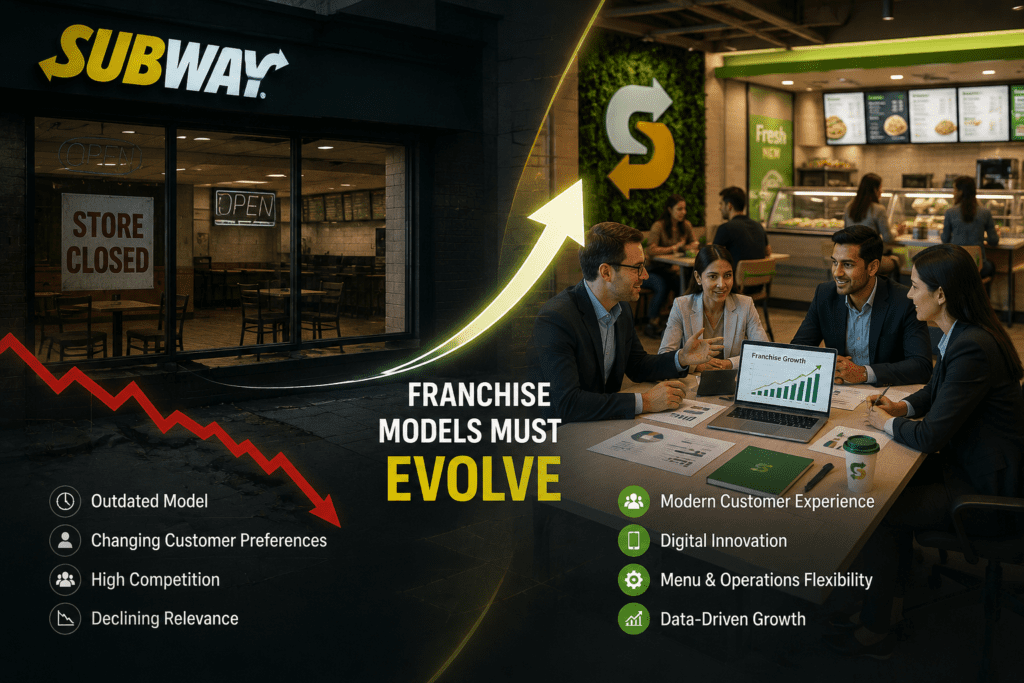
Franchise model evolution is not a strategic option for brands that want to scale long-term. It is a survival requirement. A franchise model is not a one-time architecture that you build at launch and operate against indefinitely. It is a living system that must be deliberately refreshed as markets shift, customers evolve, and competitors adapt. The brands that forget this do not fail suddenly. They fade — slowly, quietly, and often irreversibly — while their leadership team waits for conditions to return to what they once were.
The most instructive case study of what happens when a franchise model stops evolving is playing out in real time. According to Restaurant Dive, Subway has closed a net 3,417 restaurants since 2021 — its tenth consecutive year of decline. At its peak in 2015, Subway operated more than 27,000 US locations. It now has fewer than 19,000. The lesson is not about Subway as a brand. It is about franchise models as systems — and what happens when those systems are not rebuilt.
The Subway India Story — When a Franchise Model Stands Still
Subway entered India with a clear and differentiated promise — healthy fast food, customisable sandwiches, and a Western-format dining experience. For years, the model worked. Subway grew to over 600 stores across the country and became a recognisable brand in nearly every metro food court. The unit economics were defensible. The brand was distinct. The franchise system was functional.
Then the market shifted — and Subway did not.
Indian taste preferences evolved significantly. The QSR category became intensely crowded. Competitors localised aggressively and specifically:
- Burger King India introduced aggressive value pricing targeting cost-conscious consumers
- McDonald’s India launched category-defining products built around Indian taste preferences
- Domino’s continued refining its delivery economics and loyalty infrastructure
- Homegrown QSR brands like Biggies Burger and Rollsmania scaled with formats designed specifically for Indian consumer behaviour
Subway, meanwhile, stayed largely Subway. The menu evolved slowly. The store experience remained static. The franchise economics tightened. Franchisees began exiting — and the brand lost the market momentum it had spent years building.
⚠ The core failure
Subway’s decline is not a product failure or a brand failure. It is a franchise system failure — the failure to rebuild the operating model, the unit economics, the store experience, and the brand promise in response to a market that moved on without it.
The Franchise Architecture Trap
Most founders treat their franchise architecture as something they build once and then operate against. They invest heavily at the moment of launch — defining unit economics, store design, training systems, and operational playbooks. Once those documents are in place, they consider the model complete.
This is the trap. And it catches brands at every scale — from regional Indian QSR chains to global sandwich giants.
Consider what changes in any five-year period in India’s consumer markets:
- Customer expectations shift — what felt premium in 2020 feels ordinary in 2025
- Real estate costs change — rental economics that worked in 2019 may not work in the same location today
- Labour markets transform — staffing costs, availability, and skill profiles change significantly
- Competitors localise — new entrants build specifically for the evolved market, not the market that existed when the incumbent launched
- Digital channels disrupt — delivery platforms, dark kitchens, and direct-to-consumer models reshape how QSR revenue is generated
- Consumer demographics evolve — the Gen Z consumer entering the market in 2026 has fundamentally different expectations than the millennial consumer the model was designed for
A franchise model designed in 2018 was built for a different India than the one that exists in 2026. A model designed in 2026 will be increasingly out of step by 2031 unless deliberately refreshed. The market does not wait for franchise playbooks to catch up.
Markets evolve faster than playbooks. The franchise model that built your first hundred outlets will not build your next hundred — unless you rebuild it first.
What Franchise Model Evolution Actually Looks Like
Brands that succeed long-term in franchising treat their model as a five-year cycle — not a permanent architecture. Franchise model evolution is not a one-time overhaul. It is an ongoing operating discipline across five specific dimensions:
1. Annual Unit Economics Review
Unit economics are not static. Rental costs, labour costs, input costs, royalty structures, and average transaction values all shift continuously. A franchise model with healthy unit economics at launch can become commercially unviable for franchise partners within three to four years if the economics are not monitored and adjusted. Brands must review outlet-level P&L data from active franchisees annually — not as an audit exercise, but as a model health assessment.
- Are franchisees still hitting break-even within the original projected timeline?
- Have input or rental costs risen faster than revenue growth?
- Are the highest-performing outlets outperforming because of location — or because of model strength?
- What do the bottom quartile of outlets tell you about where the model is weakest?
2. Store Design Refresh Every 5 to 7 Years
Store design communicates brand relevance. A store format that looked contemporary and premium at launch will feel dated within five to seven years — not because the design was wrong, but because consumer aesthetic expectations evolve continuously. Brands that refresh store design on a structured cycle maintain brand relevance with each new customer cohort. Brands that do not find their outlets increasingly out of sync with the consumer experience their competitors are delivering.
3. Training and SOP Reassessment
Operating SOPs designed for a 2020 franchise system may not address the operational realities of a 2026 business — delivery platform management, digital ordering workflows, hygiene standards post-pandemic, and new product category requirements all change the daily operating environment. Training systems must be reviewed and updated to reflect how the business actually operates today, not how it operated when the manuals were first written.
4. Partner Profile Review
The franchise partner profile that made sense at launch may not be the right profile for the next phase of expansion. Early-stage franchise recruitment often prioritises partners who are willing to take the risk of an unproven model. At scale, the brand needs partners who can manage complexity, multi-unit operations, larger teams, and more demanding consumer expectations. Reviewing the partner selection criteria as the network matures is not a sign of inconsistency. It is a sign of operating maturity.
5. Brand Promise Validation
The most important — and least frequently done — evolution exercise is asking whether the original brand promise still resonates with the customer who walks into the store today. Not the customer the brand was designed for in 2018 or 2020. The customer standing in front of the counter right now. What do they expect? What are they comparing the brand against? What would make them choose it over the three alternatives that have opened in the same catchment since the brand launched?
💡 The five-year franchise audit checklist:
- Are franchisees still hitting break-even within the original projected timeline?
- Does the store design still feel contemporary to a new customer walking in for the first time?
- Do the SOPs reflect how the business actually operates today — including delivery, digital, and new service formats?
- Is the partner profile we are recruiting still the right profile for where the network is going?
- Does the brand promise still resonate with the customer who exists today — not the one from five years ago?
The Brands That Compound Across Decades
The brands that sustain franchise growth across decades — across categories, across geographies — are the ones that rebuild themselves quietly and repeatedly while their competitors stand still. This is not consultant theory. It is operating discipline.
Naturals Salon has maintained consistent franchise growth across India for over two decades by continuously refreshing its service menu, training framework, and salon design format in response to an evolving beauty market. The brand that exists today is structurally different from the brand that launched its first franchise — and that is precisely why it is still growing. The same principle applies to every brand in every category that has compounded over time.
The brands that stall — like Subway — are not the ones that built bad models. They are the ones that built good models and then stopped rebuilding them. The model that creates franchise success in year one becomes the franchise constraint in year ten if it is not actively evolved.
A franchise model is not built once. It is rebuilt every five years. The brands that understand this do not just grow — they compound. And Corporate Culture’s Franchise Readiness Audit is built specifically to identify where a franchise model needs to be refreshed before the market forces the issue.
Is your franchise model due for a refresh?
Corporate Culture works with franchise brands at every stage — from launch readiness to network-wide model refresh. If your franchise system was built more than three years ago and has not been formally reassessed, the market may have already moved past it.
Frequently Asked Questions
What is franchise model evolution and why does it matter?
Franchise model evolution is the deliberate, structured process of refreshing a franchise system’s unit economics, store design, training, partner profile, and brand promise in response to changes in the market, consumer expectations, and competitive landscape. It matters because a franchise model designed for one market moment will become increasingly misaligned with a different market moment if it is not actively updated. The brands that fail to evolve their franchise models do not fail suddenly — they lose relevance and franchisee viability gradually, until the network is no longer commercially sustainable.
Why is Subway’s franchise model declining?
Subway has closed a net 3,417 US restaurants since 2021 — its tenth consecutive year of decline — driven by oversaturation, low average unit volume, and a franchise model that did not evolve quickly enough to match shifting consumer preferences and aggressive competition. Competitors localised and innovated faster. Subway’s menu, store design, and unit economics did not refresh at the pace the market required. The result is a system where franchisees face commercially unviable unit economics and are exiting the network. The lesson is structural — not brand-specific.
How often should a franchise model be reviewed and updated?
Unit economics should be reviewed annually — even small shifts in rental, labour, or input costs can significantly change franchisee profitability over time. Store design should be refreshed every five to seven years to maintain brand relevance. Training systems and SOPs should be reassessed whenever significant operational changes occur — new delivery formats, new product categories, new regulatory requirements. The overall franchise model — brand promise, partner profile, and market positioning — should be formally reviewed on a five-year cycle at minimum.
What happens when a franchise model is not evolved?
When a franchise model is not evolved, four things happen in sequence. Unit economics tighten as costs rise faster than revenue. Franchisee profitability falls below viability thresholds. Franchisee exits accelerate. New partner recruitment becomes harder because the model no longer offers competitive returns. The brand loses network density, market presence, and consumer relevance simultaneously — a compounding decline that is significantly harder to reverse than it would have been to prevent through regular model refresh.
How do I know if my franchise model needs to be refreshed?
Five signals indicate a franchise model needs refreshing — franchisees are missing break-even timelines, outlet-level profitability is declining across the network, franchisee exit rates are increasing, new partner recruitment is slowing, and consumer satisfaction scores or repeat visit rates are falling. Any one of these signals warrants a model review. More than two occurring simultaneously indicates the model is already behind the market. Corporate Culture’s Franchise Readiness Audit is designed to identify exactly where the model gaps are before they become network-wide problems.
Can Indian franchise brands learn from Subway’s decline?
Yes — and the lesson is direct. Indian QSR and retail franchise markets are evolving as fast as any market in the world. Consumer expectations, competitive density, digital channel dynamics, and real estate economics are all shifting rapidly. A franchise model built for India in 2020 is operating in a materially different environment in 2026. Indian brands that treat franchise model evolution as an ongoing operating discipline — reviewing unit economics annually, refreshing store design, updating training systems, and validating brand promise regularly — will compound. Those that treat the launch-day model as permanent will face the same structural fragility that Subway is managing today.