
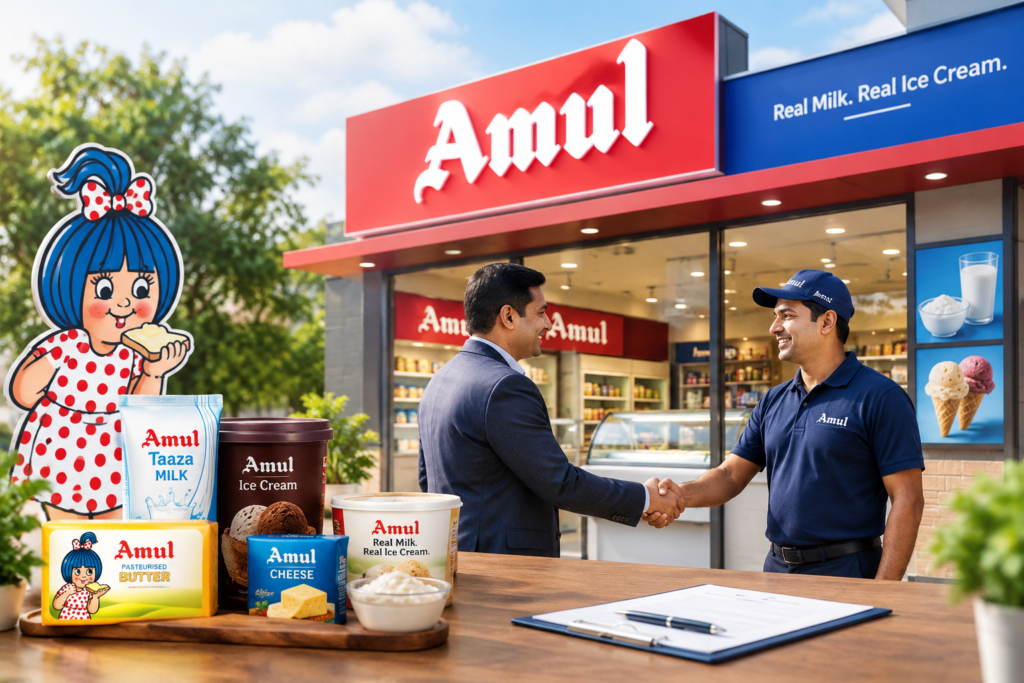
Amul charges no franchise fee and no royalty — only a refundable-in-name-only brand deposit of ₹25,000 or ₹50,000 depending on format. What each outlet actually costs, the margin on every product category, and the franchise scam that targets this exact search.
Quick answer: Amul charges no franchise fee and no royalty. You pay a non-refundable brand security deposit — around ₹25,000 for a Preferred Outlet or kiosk, around ₹50,000 for an Ice Cream Scooping Parlour — and fund your own fit-out and equipment on top. Total entry is commonly quoted at roughly ₹2 lakh for an outlet and ₹6 lakh for a scooping parlour. Margins run from 2.5% on pouch milk to around 20% on pre-packed ice cream.
Amul is unusual among Indian franchise opportunities. There is no franchise fee, no royalty, and no revenue share — the brand makes its money selling you product, not selling you a licence. That is why entry costs are low enough to put it within reach of a first-time investor, and also why the opportunity attracts more fraud than almost any other franchise in the country.
This guide covers what each format costs, what you earn on each product category, how to apply through the only legitimate route, and what the figures circulating online are actually worth.
Before the numbers — a word on where they come from. Amul does not publish a consolidated franchise cost sheet, and the figures repeated across most websites trace back to each other rather than to Amul. We have cross-checked the ranges below against several independent sources and flagged where they disagree. Treat them as indicative for planning, and confirm current terms with Amul directly before you commit any money.
Types of Amul Franchise
Amul’s retail network runs on a small number of standard formats. The two that most investors are choosing between are the outlet and the scooping parlour, and they are genuinely different businesses despite carrying the same brand.
Amul Preferred Outlet, Railway Parlour or Kiosk
A compact retail point selling the full Amul range — pouch milk, butter, cheese, paneer, curd, buttermilk, chocolates and pre-packed ice cream. The business is volume-led and margin-thin, with pouch milk in particular acting as footfall rather than profit. It suits a residential catchment, a transit location or a market street where people buy daily staples.
Amul Ice Cream Scooping Parlour
A different proposition entirely. Scooping parlours sell served ice cream, shakes, sundaes and recipe-based items prepared in-store, and the margin on those prepared items is several times what packaged goods return. It needs more space, more equipment and staff who can serve, but the economics per square foot are considerably stronger. It suits high-footfall evening locations — malls, high streets, near cinemas or colleges.
Amul Café and larger lounge formats
A larger café format also exists, running to 1,000 sq ft and beyond with a kitchen serving pizzas, sandwiches and hot beverages alongside ice cream. Reported investment for this format varies widely between sources — from around ₹6–10 lakh at the smaller end to ₹30 lakh for a full café — so treat any single figure for it with particular caution and ask Amul directly.
Amul Franchise Cost: Investment and Security Deposit
The deposit is the only money that goes to Amul. Everything else is spent on your own premises and equipment, which means you control a large part of the total.
| Preferred Outlet / Kiosk | Ice Cream Scooping Parlour | |
|---|---|---|
| Brand security deposit | ₹25,000 (non-refundable) | ₹50,000 (non-refundable) |
| Renovation / fit-out | ~₹1,00,000 | ~₹4,00,000 |
| Equipment | ~₹70,000–75,000 | ~₹1,50,000 |
| Indicative total | ~₹2 lakh | ~₹6 lakh |
| Space required | 100–150 sq ft | 300 sq ft minimum |
| Franchise fee | None | None |
| Royalty / revenue share | None | None |
Note the word non-refundable. The brand security deposit is widely described as a “security deposit”, which implies you get it back. The sources that describe it in any detail say it is not returned. Confirm this point specifically before paying, because it changes how you should think about the number.
Where sources disagree: one major franchise portal lists outlet investment at ₹3–6 lakh rather than ₹2 lakh, and does not mention the deposit at all. The same page states in its text that Amul charges no royalty while its own summary table shows 10%. That is the level of care behind most published Amul figures, and the reason we would not plan a business on any single one of them.
What the quoted figures exclude, as with any franchise: rent and security deposit on the premises, which in a metro high street can exceed the entire franchise investment; initial stock; staff salaries; and working capital for the first few months. Our breakdown of the full cost of opening a food franchise covers the lines that quoted figures routinely leave out.
Amul Franchise Margins by Product
This is the part that decides whether the business works, and it is where the two formats diverge sharply. Margins are calculated on MRP.
| Product category | Retailer margin | Available in |
|---|---|---|
| Pouch milk | ~2.5% | Outlet |
| Milk products (butter, cheese, paneer, curd) | ~10% | Both |
| Pre-packed ice cream | ~20% | Both |
| Scooped ice cream, shakes, sundaes, recipe items | up to ~50% | Scooping parlour only |
Read the 2.5% carefully. On a ₹30 milk pouch you earn about 75 paise. Pouch milk is not a profit line — it is a reason for customers to visit daily, and the business is made on what they add to the basket. An outlet whose sales are mostly pouch milk will struggle regardless of turnover.
And treat the 50% with care. It is the figure most often used to sell the scooping parlour, and at least one source describes it as the share of parlour revenue coming from recipe-based items rather than the margin on them. The two are not the same thing. Ask Amul to state the margin on served items specifically before you build a plan around it.
The structural point holds either way: packaged goods carry thin margins, prepared items carry fat ones, and that is why the scooping parlour earns more per square foot despite costing three times as much to open.
A Realistic Monthly Profit Example
Published turnover figures for Amul outlets range from ₹3–6 lakh a month at one source to ₹5–10 lakh at another. Rather than pick one, here is how the arithmetic actually works, so you can run it on whatever number your own location supports.
A scooping parlour doing ₹5 lakh a month, with roughly half that revenue from served items at a higher margin and half from packaged goods at around 20%, generates a gross margin somewhere in the region of ₹1.5–1.75 lakh. From that you pay:
- Rent — the largest variable, and in a high-footfall location the one that decides the outcome
- Staff — a scooping parlour needs service staff through trading hours
- Electricity — freezers run continuously, and this is materially higher than a dry retail format
- Consumables, wastage and local marketing
Whether what remains is a good return depends almost entirely on rent. The honest test is the one that applies to every food franchise: keep occupancy cost within roughly 6–10% of sales. A parlour paying ₹60,000 rent against ₹5 lakh of sales is at 12% and already difficult. The same parlour at ₹35,000 is comfortable.
Be sceptical of any payback claim quoted without a rent figure attached. Published payback ranges for Amul outlets sit around six to eleven months, which is achievable on low rent and optimistic on high rent.
How to Apply for an Amul Franchise
There is one legitimate route, and it runs through Amul’s own website at amul.com. Amul appoints outlets directly. It does not work through franchise agents, consultants or third-party “registration” portals.
- Apply through the official site. Use the parlour or franchise section of amul.com and submit your enquiry there, with your proposed location and the format you want.
- Have the site ready before you apply. Amul assesses the location, so a specific address with the right footprint strengthens the application considerably over a general expression of interest.
- Expect site approval, then an agreement, then fit-out to Amul’s specification, followed by stock supply through the local distributor.
- Pay only Amul, and only what the agreement states. This is the point at which most fraud happens.
Warning: The Amul Franchise Scam Targets This Exact Search
Amul does not charge agents, and it does not take a “registration fee”. Anyone asking you for one is defrauding you.
This is not a general caution. It is a documented fraud, and it specifically targets people searching the terms that brought you to this page.
Gujarat Cooperative Milk Marketing Federation, which owns Amul, filed a police complaint over fraudulent search advertisements selling Amul franchises, and issued a legal notice to Google India in January 2019 demanding the fake sites be withdrawn. As Business Standard reported, the fraudulent ads bid on the keywords “Amul Franchisee”, “Amul Parlor” and “Amul Distributor”.
The method was simple. Victims clicked the advertisement, filled in a form, received a call, and were asked for a “registration fee” of anywhere between ₹25,000 and ₹5 lakh. Once they paid, communication stopped. Then managing director R S Sodhi said some victims reported paying ₹3 to ₹6 lakh, and described the problem plainly: “They were under the impression that they were dealing with Amul.”
The pattern has not gone away — fact-checkers were still debunking fake Amul opportunity offers circulating on social media in late 2025.
How to tell a fake from the real thing
- Any “registration fee” is a scam. The legitimate deposit is paid to Amul under a signed agreement, not to a website before you have been approved for anything.
- Check the domain. Fraudulent sites use lookalike domains with Amul in the name. The real one is amul.com.
- Be wary of instant approval. Amul assesses the location before appointing an outlet. Anyone approving you on a phone call without seeing a site is not Amul.
- Never pay to a personal account. Nor by UPI to an individual, for anything described as a franchise fee, agent commission or priority processing.
Pros and Cons of an Amul Franchise
| In its favour | Against it |
|---|---|
| No franchise fee and no royalty — rare in Indian franchising | Thin margins on the highest-volume products |
| Low entry cost relative to almost any other food franchise | Little pricing freedom; you sell at MRP |
| Brand recognition that needs no explaining to customers | Earnings are capped by footfall and basket size, not by effort |
| Established supply chain and predictable daily demand | Outlet formats are small, so absolute profit per outlet is modest |
| Short payback in a low-rent location | Rent in a good location can erase the margin advantage entirely |
The honest summary: Amul is a low-risk, low-ceiling business. It is a sound first franchise and an efficient use of a modest budget, particularly in the right residential or transit catchment. It is not a route to large profit from a single outlet, and investors who treat it as one are usually disappointed. If you are weighing it against other categories, our guide to choosing the right food franchise in India sets out the six checks that decide whether any opportunity is worth signing.
Frequently Asked Questions
What is the Amul franchise cost in 2026?
Entry is commonly quoted at around ₹2 lakh for an Amul Preferred Outlet or kiosk and around ₹6 lakh for an Ice Cream Scooping Parlour. That covers a non-refundable brand security deposit of ₹25,000 or ₹50,000 respectively, plus fit-out and equipment. It excludes rent, deposit on the premises, stock and working capital. Amul does not publish a consolidated cost sheet, so confirm current figures directly before committing.
Does Amul charge a franchise fee or royalty?
No. Amul charges no franchise fee, no royalty and takes no share of revenue or profit — the brand earns from supplying product to the outlet. The only payment to Amul at the outset is the brand security deposit. Anyone asking for a separate “registration fee” or agent commission is not acting for Amul.
How much profit does an Amul parlour make per month?
It depends almost entirely on rent and product mix. Published monthly turnover figures range from ₹3 lakh to ₹10 lakh depending on the source and location. On ₹5 lakh of scooping parlour sales, gross margin lands somewhere around ₹1.5–1.75 lakh before rent, staff, electricity and wastage. Keep occupancy cost within 6–10% of sales or the margin disappears.
What is the margin on Amul products?
Roughly 2.5% on pouch milk, around 10% on milk products such as butter, cheese and paneer, and about 20% on pre-packed ice cream, all calculated on MRP. Scooping parlours earn substantially more on served items like scoops, shakes and sundaes — figures up to 50% are widely quoted, though at least one source describes that as the revenue share from recipe items rather than the margin, so it is worth confirming.
How much space is needed for an Amul franchise?
An Amul Preferred Outlet or kiosk typically needs 100–150 sq ft. An Ice Cream Scooping Parlour needs a minimum of around 300 sq ft to accommodate freezers, a service counter and preparation space. Larger café formats run to 1,000 sq ft and above.
Is the Amul security deposit refundable?
It is generally described as a non-refundable brand security deposit, despite the name. Because the wording varies between sources, ask Amul to confirm in writing whether the deposit is returned at the end of the term before you pay it.
How do I apply for an Amul franchise?
Apply directly through amul.com. Amul appoints outlets itself and does not operate through franchise agents or third-party registration portals. Identify your proposed location first, since Amul assesses the site as part of the decision. Never pay a fee to any intermediary — fraudulent sites advertising Amul franchises have been the subject of a police complaint and a legal notice to Google from Amul’s parent cooperative.
Weighing Amul Against Other Food Franchises?
Corporate Culture places investors into food and beverage brands across India, and we are straightforward about where a given opportunity fits. Amul is a sound low-budget entry. If your budget runs higher, there are formats with materially better unit economics that we work with directly — and we will tell you which ones suit your city and budget rather than selling you the first one that pays us.
📞 WhatsApp or call +91 63819 37457