
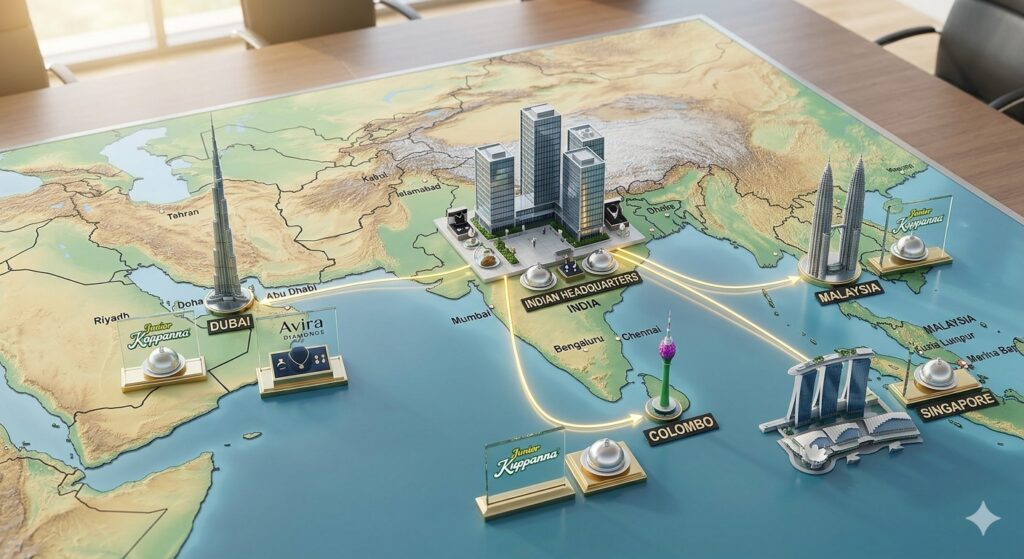
Two Indian brands we work with reached Dubai by opposite routes. Junior Kuppanna went on sixty years of equity through a joint venture. Avira Diamonds went from no brand at all to seven stores in forty months. What each route costs and which one fits your business.
Quick answer: There is no single route for an Indian brand to expand its franchise abroad, and the two we have taken brands through look nothing alike. Junior Kuppanna went international on six decades of brand equity, through a joint venture with a strategic partner, at USD 300,000 to 400,000 per outlet. Avira Diamonds went from no brand, no structure and no national presence to six Indian stores and one in Dubai in forty months, through franchise stores. Which route fits you depends almost entirely on what you already have.
Most writing about international franchising describes one path and implies it is the path. These are two of ours, with the figures we worked to, and they are useful precisely because they contradict each other.
Junior Kuppanna, Sixty Years of Equity Then a Joint Venture
Junior Kuppanna is a Kongu cuisine restaurant brand from Tamil Nadu with more than sixty years of trading behind it. It did not franchise early. It standardised recipes, operating procedures and supply chain first, then franchised, then went abroad, in that order.
It now trades internationally in Kuala Lumpur, Colombo and Dubai.
| India | International | |
|---|---|---|
| Total investment | ₹50 lakh to ₹1 crore | USD 300,000 to 400,000 |
| Franchise fee | ₹10 lakh to ₹15 lakh | USD 50,000 |
| Space | 2,500 to 3,500 sq ft | 2,500 to 4,000 sq ft, 80 plus seating |
| Structure | Franchise | Joint venture with strategic partner hold |
| Return | Break even in 3 to 4 years | ROI typically within 3 years |
| Term | — | 5 plus 5 years |
Two things in that table are worth sitting with.
The international outlet costs roughly two and a half to six times the Indian one, for a similar footprint. That gap is rent, fit out, imported inputs and compliance, and it is why a format has to be genuinely profitable at home before it travels.
And the structure changes at the border. India is a franchise. International is a joint venture with a strategic partner holding a stake. That is a deliberate choice, not a formality, and it reflects how much more a brand has to rely on a local partner’s judgement in a market it cannot supervise weekly. Full figures and locations are in our Junior Kuppanna franchise guide for India and abroad.
Avira Diamonds, Forty Months From Nothing to Dubai
Avira Diamonds started where Junior Kuppanna had already been for half a century. No expansion blueprint, no franchise structure, no national presence. This was not franchise development added to an established brand. It was building the brand and the network at the same time.
That meant work well outside franchise recruitment: positioning from first principles, PR and celebrity led launches to build recognition quickly, franchise events and expo presence to reach investors directly, a structured investor pipeline, and presentation material that answered the financial questions before they were asked.
The outcome over forty months was six franchise stores across India and one international franchise store in Dubai.
Forty months is the number that matters, and it is not fast. It should not be. A brand with no recognition cannot credibly sell territory rights in its first year, and the sequence that worked was recognition first, then structure, then investors. Reversing that order is the most common way a young brand burns its early franchisees. The full case sits in our account of building jewellery networks across India and the GCC, alongside Limelight Diamonds and Wondr Diamonds.
Both Landed in Dubai and Neither Chose a Mall
The detail that says most about how these moves were made is where the Dubai outlets went.
Junior Kuppanna’s Dubai restaurant is in Al Karama. Not a destination mall on Sheikh Zayed Road. A dense, established, heavily South Asian residential district where the customer already knows what Kongu cuisine is and does not need persuading to try it.
That is the whole Gulf strategy in one address. Prime mall rent in Dubai can consume the entire margin advantage that attracted a brand to the market in the first place, and an outlet that breaks its occupancy ratio will struggle whatever the footfall. A community catchment proves the format at a rent the model can actually carry. The mall, if it ever comes, is funded later by a business that already works.
We set out the full framework for that decision in how to choose the right country for franchise expansion, including the five tests a market has to pass before it is worth entering.
What the Two Routes Have in Common
A sixty year old restaurant brand and a jewellery startup took opposite paths. Three things still held for both.
- The system existed before the border was crossed. Junior Kuppanna standardised recipes, procedures and supply chain before franchising at all. Avira spent most of forty months building what a franchisee would be buying. Neither sold territory it could not yet support.
- The first international outlet went where the product needed no explaining. Dubai for both, with an established South Asian population and a short flight from India. Neither opened in a market where year one would have been spent educating customers.
- Someone local carried real responsibility. A joint venture partner in one case, a franchise partner in the other. In neither case was the outlet run remotely from India.
What differed was the starting point, and that is the only thing that should decide your own route.
Which Route Fits Your Brand
| If your brand is | The route that usually fits | Realistic timeline |
|---|---|---|
| Established, documented, recognised at home | Joint venture or master partner in one market | 12 to 24 months to first international outlet |
| Profitable but not yet franchised anywhere | Franchise domestically first, abroad later | Domestic system first, then 12 months plus |
| Early, with no recognition outside its own city | Build brand and structure together, as Avira did | Three years or more, and that is normal |
| Being asked by an overseas investor right now | Assess the market independently of the enquiry | Weeks, to find out whether it is real |
That last row is the most common situation and the most mishandled. An enthusiastic enquiry from a country nobody was considering is not a strategy, and it is how a large share of Indian brands end up in their first overseas market. Keep the candidate if they are credible. Assess the country separately.
What Has to Be Settled Before Either Route
Both routes run into the same three obstacles, and they sit outside the commercial negotiation entirely.
- Your Indian trademark protects you in India and nowhere else, and most of the world awards a brand to whoever files first rather than whoever used it first.
- Royalties arrive after foreign withholding tax, so a 10% royalty in an agreement is not 10% received.
- India imposes no franchise disclosure obligations on you, and several target markets do, with registration and waiting periods attached.
Each of these has ended expansion plans that were otherwise sound. We cover all three in what Indian brands must fix before franchising abroad, and the partner side in choosing a master franchise partner abroad.
How We Work on an International Expansion
Corporate Culture works with Indian brands across food, beauty, retail and luxury, and we have built networks across India and the Gulf. In jewellery alone we have placed over ₹100 crore of franchise investment across India and the GCC.
What the engagement covers depends on where you are starting, which is the point of the two cases above.
- Market assessment against the five tests, before any partner conversation
- Unit economics rebuilt at local costs, not converted from the Indian model at the exchange rate
- Structure selection, whether joint venture, master partner, area developer or single unit
- Partner identification and qualification, applying the same criteria to every candidate
- Brand and investor material that answers the financial questions before they are asked
- Agreement terms set commercially before a lawyer drafts them
For an early stage brand that list starts much further back, with positioning and recognition, as it did with Avira. If that is where you are, we will say so. A brand told to wait eighteen months and given a list of what to fix is better served than one sold a roadmap it cannot run.
Frequently Asked Questions
How much does an international franchise outlet cost compared with India?
Considerably more for a similar footprint. Junior Kuppanna’s Indian outlets run ₹50 lakh to ₹1 crore with a franchise fee of ₹10 lakh to ₹15 lakh, while its international outlets run USD 300,000 to 400,000 with a USD 50,000 franchise fee, on 2,500 to 4,000 sq ft with 80 plus seating. The gap is rent, fit out, imported inputs and compliance, which is why a format needs to be genuinely profitable at home before it travels.
How long does it take an Indian brand to open its first overseas outlet?
It depends entirely on the starting point. An established brand with documented operations and recognition at home can reach a first international outlet in roughly twelve to twenty four months. A brand starting without recognition or a franchise structure takes far longer. Avira Diamonds reached six Indian stores and one in Dubai over forty months, because recognition had to be built before territory could credibly be sold.
Should an Indian brand use a joint venture or a franchise abroad?
Both are used and the choice reflects how much local judgement the business needs. Junior Kuppanna franchises in India but uses a joint venture with a strategic partner holding a stake for international outlets, because a market you cannot supervise weekly relies far more on the local partner. Avira used franchise stores. Category, ticket size and how much control the format requires all feed the decision.
Why do Indian brands open in Dubai first?
Because the product needs no explaining to an established South Asian population, flights from India are three to four hours, the time difference is under two hours so real support is possible, and shipping routes are short. The weak point is rent. Brands that do well there tend to open first in a community catchment rather than a destination mall, which is why Junior Kuppanna’s Dubai restaurant sits in Al Karama.
Can a new brand franchise internationally without a strong domestic network?
It can, but the sequence has to be recognition first, then structure, then investors, and that takes years rather than months. Avira Diamonds did it in forty months while building brand and network at the same time. A brand that reverses the order and recruits franchisees before the system exists is asking those franchisees to fund its learning curve, and the reference calls that follow stay with the brand.
An overseas investor has approached us. Should we proceed?
Keep the candidate if they are credible, but assess the country independently of them. Most Indian brands end up in their first overseas market because an enthusiastic individual from there got in touch, which means an inbound enquiry has decided the strategy. Run the market through proper selection tests covering demand, supply chain, local unit economics, the legal regime and whether you can physically support an outlet there.
Thinking About Taking Your Brand Abroad
Tell us your outlet count, your per outlet numbers and the markets you are considering. We will tell you which route your brand is actually ready for, and if the honest answer is that you are not ready to leave India yet, we will tell you that and what to fix first.
Our international franchise expansion service sets out how the engagement runs, and the Franchise Readiness Audit returns a readiness score, gap report and roadmap if you would rather start with a structured assessment.
📞 WhatsApp or call +91 63819 37457