
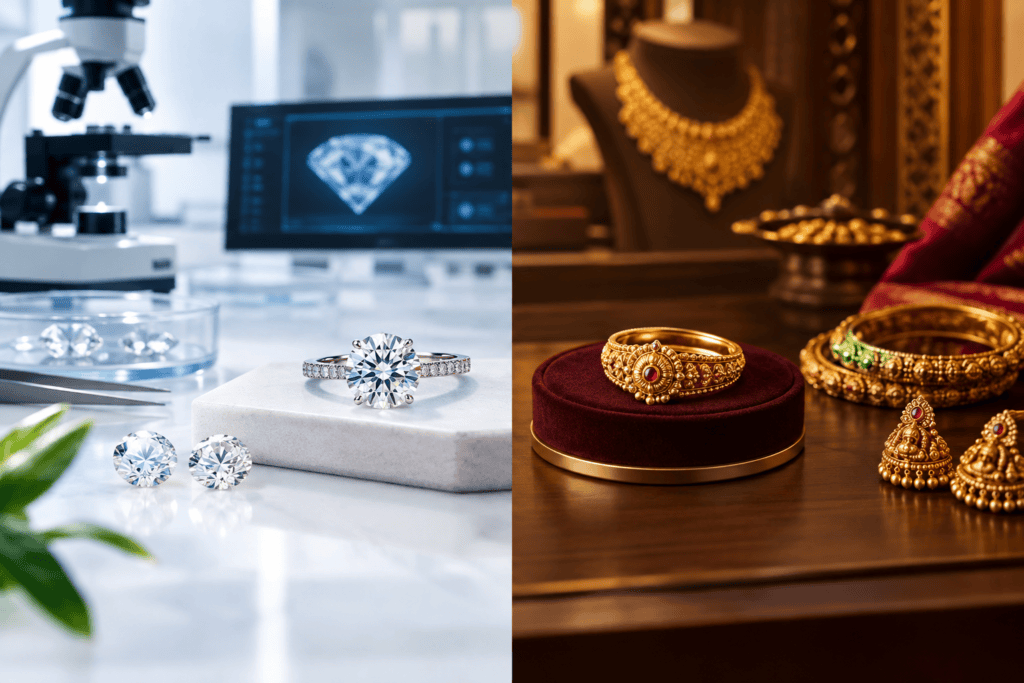
A traditional gold jewellery franchise and a lab-grown diamond franchise both sell jewellery, but they are different businesses financially. Entry capital, margin, operating model and risk compared.
Quick answer: A traditional gold jewellery franchise and a lab-grown diamond franchise both sell jewellery, but financially they are different businesses. Traditional formats commonly require ₹3 crore or more upfront, most of it tied up in gold inventory, and return a single-digit to low-teens margin. Lab-grown formats start far lower because the stock costs a fraction of gold, and carry higher retail margins — against a younger category with less resale history. The deciding question is not which product you prefer. It is how much capital you can leave sitting in a display case.
Most investors evaluating a jewellery franchise in India compare brands. That is the wrong first comparison. The gap between a gold-led franchise and a lab-grown diamond franchise is wider than the gap between any two gold brands, and it shows up in the one number that decides whether you can actually fund the business: working capital.
This guide sets both routes side by side — entry capital, margin, operating model and risk — so you can work out which one your balance sheet supports before you start shortlisting brands.
Jewellery Franchise in India: The Two Routes
India’s organised jewellery retail splits into two franchise propositions:
- Traditional gold and diamond jewellery. Established national brands with decades of trust, large store formats, and a business model built around financing gold inventory. Bridal and wedding purchases drive the bulk of revenue.
- Lab-grown diamond jewellery. A newer, faster-growing category. Smaller formats, substantially lower stock cost, and customers who are buying design and certification rather than stored value.
Both are legitimate businesses. They suit very different investors.
Investment Compared: Where the Money Actually Goes
The table below uses published franchise terms for two of India’s largest traditional jewellery networks, set against the lab-grown range. Figures are compiled from published franchise databases and brand disclosures; confirm current terms directly with any brand before committing.
| Tanishq (traditional) | Kalyan Jewellers (traditional) | Lab-grown diamond | |
|---|---|---|---|
| Store setup | ₹50 lakh | Part of ₹2 crore total | Varies by brand and format |
| Franchise fee | ₹15 lakh | ₹20 lakh | Varies by brand |
| Security deposit | ₹50 lakh | ₹50 lakh | Varies by brand |
| Working capital | ₹3 crore | ₹50 lakh | Materially lower — stock cost is a fraction of gold |
| Total upfront | ~₹4.15 crore | ~₹3.2 crore | ₹60 lakh – ₹1.5 crore independent store; branded formats to ₹2.9 crore |
| Space | 800+ sq ft | 1,500+ sq ft | Studio to flagship |
| Royalty | 8% of revenue | Nil | Varies by brand |
| Margin | ~6–12% gross | 12–18% gross, 8–12% net | Higher than gold retail; brand-dependent |
| Operating model | FOFO — owner-operated | FOCO — brand-operated | Both models in the market |
| Network size | 518 stores | 436 stores | Smaller, growing quickly |
Read the working capital row again. Tanishq’s published terms call for roughly ₹3 crore of working capital on top of a ₹50 lakh store build. That is not a quirk of one brand — it is what gold retail requires.
Why Gold Jewellery Franchises Need So Much Capital
A gold jewellery store is, financially speaking, an inventory financing business with a shopfront attached.
To trade credibly you must hold a wide range of designs, weights and price points. Every one of those pieces is gold at prevailing rates. A display case that looks ordinary to a customer can hold crores of stock. That capital sits there until someone buys it, and you cannot thin the range without losing the sale — a bridal customer who does not find her design walks to the store next door.
Three consequences follow, and they decide the economics:
- Your return is on a very large base. A 10% margin on a business holding ₹3 crore of stock is a different proposition from 10% on ₹30 lakh of stock. The percentage flatters; the capital employed does not.
- You carry gold price exposure. Stock bought at one rate and sold at another moves your margin in ways your retail performance did not cause.
- Inventory rotation becomes the real KPI. Slow-moving designs are not just unsold goods; they are frozen capital you are financing.
Lab-grown diamond retail inverts this. The stones cost a fraction of natural equivalents, so the same visual range of inventory ties up far less money. Capital shifts out of the display case and into store experience, staff and marketing — which is where a retailer can actually influence the outcome.
Gold jewellery retail asks how much capital you can leave idle. Lab-grown asks how well you can sell. Those suit different people, and most investors know which one they are before they admit it.
Margin: The Percentage Is Not the Point
Published terms put Kalyan Jewellers franchisees at roughly 12–18% gross and 8–12% net, and Tanishq at roughly 6–12% gross after inventory cost, royalty and operating expenses. Tanishq also charges 8% royalty on revenue where Kalyan charges none — a reminder that two brands in the same category can have very different economics.
Lab-grown diamond retail generally carries higher percentage margins, because procurement cost is lower while retail pricing holds up on design, certification and brand. But percentage margin on its own is a poor comparison. What matters is margin against capital employed, and against how fast stock turns.
The honest way to compare two jewellery franchise offers is to ask the same three questions of each: how much total capital is committed including working capital, what net margin remains after royalty and operating cost, and how many times a year does the stock turn. A brand that will not answer the third question is telling you something.
For the mechanics of how fees and royalties are structured across Indian franchising, see our guide to franchise fee and royalty in India.
The Operating Model Difference Most Investors Miss
The two brands above do not just differ on money. They differ on who runs the store.
Tanishq operates a FOFO structure — Franchise Owned, Franchise Operated. You fund the store and you run it, full time. Kalyan operates FOCO — Franchise Owned, Company Operated. You fund the store and the brand’s team runs it, with the franchisee taking an agreed return rather than operating profit.
That single difference changes what kind of investor each suits far more than the brand name does. If you have capital but a job you intend to keep, a FOFO jewellery store is not a passive investment and will not behave like one. If you want to build and run a retail business, a FOCO structure hands away the part you came for.
Both structures appear in lab-grown diamond franchising too. Before comparing any two jewellery brands, read our full breakdown of FOCO vs FOFO — the model you sign decides your daily life for the next five years.
Where Lab-Grown Carries More Risk
A fair comparison has to state the other side. Lab-grown diamond retail is the newer category and it carries risks gold does not:
- Resale and exchange expectations. Indian buyers are used to jewellery holding value and being exchangeable. Lab-grown is bought primarily as adornment rather than stored value, and customers need to understand that at the point of sale. Check what exchange or buy-back policy the brand offers, because you will be asked.
- Price movement in the category. Lab-grown stone prices have fallen as production capacity has grown. Falling procurement cost helps margin, but it also means inventory bought today may be replaceable more cheaply later.
- Certification literacy. Customers increasingly ask which laboratory certified the stone. A store that cannot explain IGI or GIA certification, or the difference between CVD and HPHT production, loses credibility in the conversation that decides a high-value sale.
- Shorter brand track records. Most lab-grown networks are a few years old. You have less history to assess than with a brand that has traded for thirty years.
None of these are reasons to avoid the category. They are the questions to put to a brand before signing, and the answers separate a serious franchisor from an opportunistic one.
What a Lab-Grown Network Looks Like at Scale
Disclosure: Limelight Diamonds is a brand we represent on franchise development. The figures below are the company’s own published numbers and we have marked them as such.
For an investor assessing whether lab-grown has moved past the pilot stage, scale is the test. Limelight Diamonds, founded by Pooja Sheth Madhavan, reports 50-plus exclusive brand outlets across 40-plus Indian cities, revenue of ₹126 crore in FY25, ₹250 crore raised for expansion and a stated target of 200-plus stores by 2027. Franchise investment is approximately ₹2.9 crore for its exclusive showroom format; the brand has withdrawn the lower-cost compact option it previously offered.
That figure is worth noting for the comparison in this guide, because it shows the category is not uniformly cheap to enter. A flagship lab-grown showroom from an established brand lands in the same bracket as a traditional gold store. The capital advantage sits further down the market — in independent stores and in shop-in-shop formats inside existing jewellery retailers, where stock cost rather than brand positioning sets the floor.
Full brand detail is in our Limelight Diamonds franchise guide, and for a worked example of how a lab-grown network is built city by city, see how we facilitated ₹20+ crore in lab-grown diamond franchise deals across seven stores in six months.
Which Jewellery Franchise Suits Which Investor
| If this is you | Look at | Because |
|---|---|---|
| ₹3 crore-plus available and comfortable holding it in stock | Traditional gold | Established demand, deep trust, decades of trading history |
| ₹25–75 lakh to deploy | Lab-grown shop-in-shop, or an independent store | Traditional gold has no entry point at this level |
| You want a hands-off investment | A FOCO structure in either category | The brand’s team operates; you take an agreed return |
| You want to build and run a retail business | A FOFO structure in either category | Operating profit is yours, and so is the daily work |
| You already own a jewellery store | Lab-grown shop-in-shop | Adds a margin line without launching a separate business |
| Priority is capital preservation | Traditional gold | The underlying metal holds value independently of the retail business |
What to Verify Before You Sign
Whichever route you take, get written answers to these before any deposit changes hands:
- Total capital including working capital. Quoted investment figures routinely exclude it, and in jewellery it is the largest line.
- Who owns the inventory. Consignment stock and purchased stock are entirely different risks on your balance sheet.
- Stock rotation and return policy. What happens to designs that do not sell in your catchment, and who absorbs them.
- Territory protection. Some brands explicitly retain the right to open nearby. Get the radius in writing.
- Store-level financials from comparable outlets. Same city tier, same format, same age. A brand confident in its model will share them.
- Exit and transfer rights. An investment you cannot sell is not an asset.
Our guide to franchise agreement clauses that protect you — and trap you covers the contractual side in detail.
Weighing a jewellery franchise?
We place investors into jewellery franchise opportunities across India and the GCC, and we work with brands on their franchise expansion. Tell us your budget and whether you intend to run the store yourself, and we will tell you which route fits — including where we would advise against a format for your situation.
Frequently Asked Questions
How much does a jewellery franchise cost in India?
Traditional gold jewellery franchises typically require ₹3 crore or more in total upfront commitment. Published terms put Tanishq at roughly ₹4.15 crore including ₹3 crore of working capital, and Kalyan Jewellers at roughly ₹3.2 crore. Lab-grown entry is generally lower because stock cost is a fraction of gold: an independent lab-grown store typically needs ₹60 lakh to ₹1.5 crore, though flagship formats from established brands reach ₹2.9 crore.
Which is more profitable, a gold or lab-grown jewellery franchise?
Lab-grown generally carries higher percentage margins because procurement cost is lower. But percentage margin alone is misleading in jewellery. A gold store earning 10% does so on a much larger capital base, while a lab-grown store earns a higher percentage on less capital employed. Compare return against total capital committed, not headline margin.
Why do gold jewellery franchises need so much working capital?
Because the inventory is gold. A credible store must hold a wide range of designs, weights and price points, and every piece carries the metal’s value. Published franchise terms for Tanishq call for around ₹3 crore of working capital on top of the store build. That capital stays in the display case until the pieces sell.
Do lab-grown diamonds have resale value in India?
Lab-grown diamonds are bought primarily as jewellery rather than as stored value, and they do not carry the exchange expectations Indian buyers associate with gold. Some brands offer their own exchange or buy-back policies. As a franchise investor you should confirm exactly what policy the brand supports, because customers will ask at the point of sale.
Can I add lab-grown diamonds to an existing jewellery store?
Yes, and for established jewellers it is often the lower-risk entry. Shop-in-shop and counter formats let you add a higher-margin category inside your current store without launching a separate business or committing to a full franchise build. Several lab-grown brands run this format alongside their exclusive outlets.
Is a jewellery franchise a passive investment?
Only under a FOCO structure, where the brand’s team operates the store and you take an agreed return. Under FOFO you fund the store and run it yourself, and jewellery retail margins assume an owner present. Tanishq operates FOFO; Kalyan operates FOCO. Confirm which model applies before assuming either.
Which jewellery brands offer franchises in India?
On the traditional side, Tanishq operates 518 stores and Kalyan Jewellers 436, both with published franchise programmes. In lab-grown diamonds the networks are newer and smaller but expanding quickly. Terms differ substantially between brands and change frequently, so verify the current structure directly with the franchisor rather than relying on a published list.
Continue reading
- Is a lab-grown diamond business profitable in India?
- Lab grown diamond franchise in India — investment, brands and profit guide
- Top 5 lab grown diamond franchise opportunities in India
- Limelight Diamonds franchise cost, owner and expansion plans
- FOCO vs FOFO — which franchise model is right for your brand?
Investment figures for Tanishq and Kalyan Jewellers are compiled from published franchise databases and brand disclosures as at October 2026. Limelight Diamonds figures are the company’s own published numbers. Terms change; verify current details directly with any brand before committing capital. This guide is general information, not investment advice.