
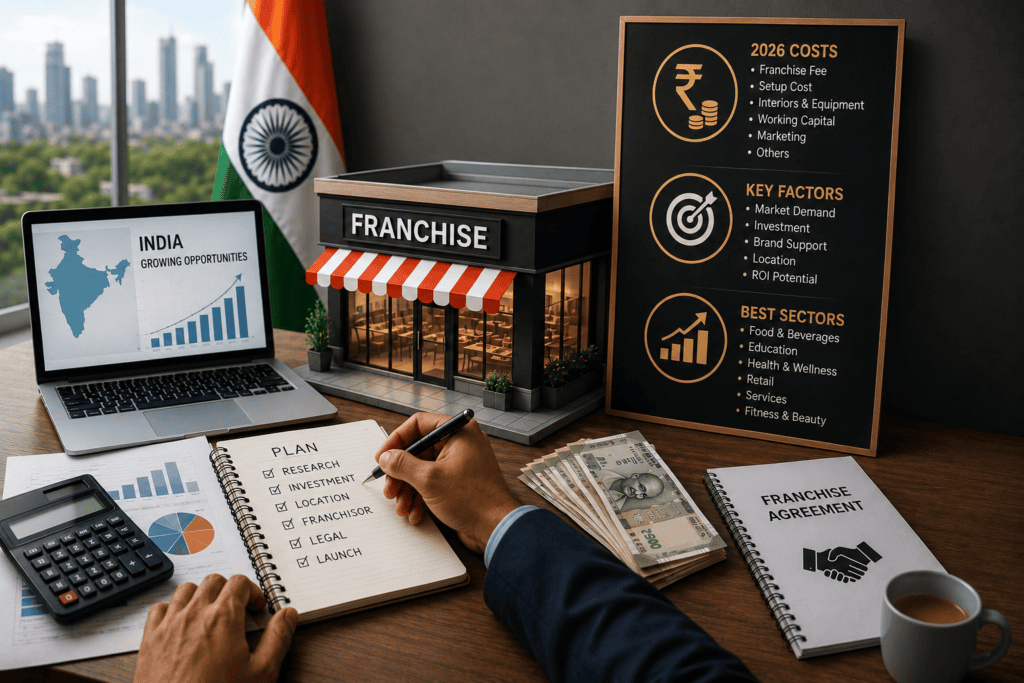
The franchise business in India has become one of the most reliable routes to entrepreneurship for first-time owners and seasoned investors alike. Instead of building a brand, a supply chain, and a customer base from zero, you plug into a system that already works — a tested model, a recognised name, and operational support from day one. For a country adding a large, aspirational middle class every year, that lower-risk pathway is powerful, and the numbers reflect it.
As of early 2026, India’s organised franchise market has crossed the ₹15,000 crore mark, up from roughly ₹12,500 crore in 2024 and about ₹4,500 crore in 2018 — a compound annual growth rate of nearly 25% over six years. Industry estimates now place franchising at close to 3% of India’s GDP, a sharp rise from around 1.8% in 2018. With roughly 4,600 active franchisors and more than 300 new franchise brands launching every year, franchising is no longer a niche play — it is a mainstream engine of jobs, retail formalisation, and small-town economic growth.
This guide is written for two readers: the franchisee investor deciding where to put capital, and the brand deciding whether and how to scale. It covers the current scenario, the most profitable sectors, real investment costs, a step-by-step setup process, and the questions to ask before signing anything. For the wider brand-and-investor overview, see our complete franchise guide for brands and investors in India.
The Current State of the Franchise Business in India (2026)
Franchising in India is being pushed forward by three structural forces: rising disposable incomes, rapid urbanisation, and deep digital adoption that now reaches Tier 3 and Tier 4 towns. A decade ago, owning a branded QSR outlet or a diagnostics lab meant being in a metro. Today, franchisees are opening the same formats in smaller cities where rents are lower and competition is thinner.
A few data points define the moment:
- Market trajectory: Industry bodies project the Indian franchise sector to reach USD 140–150 billion in turnover within the next five years, making it one of the fastest-growing franchise markets in the world.
- Multi-unit momentum: Around 53% of all franchises in India are now operated by multi-unit franchisees — a strong signal that owners who succeed with one outlet reinvest in more.
- Global context: The worldwide franchise market is on track to grow by roughly USD 565 billion between 2025 and 2030 at about a 10% CAGR, according to Technavio, so India’s expansion sits inside a broader global tailwind.
- Policy and data: Organisations such as the India Brand Equity Foundation (IBEF) note that Indian consumer-goods and services brands remain under-penetrated abroad, giving domestic franchise operators significant room to scale both at home and across South Asian markets.
For a deeper read on how Indian investors actually allocate capital across sectors and budgets, see our breakdown of franchise industry investment preferences in India. The strategic takeaway is simple: sector selection now matters more than brand selection. A mid-tier brand in a high-demand, low-competition category will usually outperform a famous name in a saturated, low-margin one.
How the Franchise Model Actually Works

In a franchise, the franchisor grants a franchisee the right to operate under an established brand, using its products, systems, and standard operating procedures. In exchange, the franchisee typically pays an upfront franchise fee plus ongoing royalty fees (usually a percentage of revenue), and agrees to run the outlet according to a binding franchise agreement.
What the franchisee gets in return is meaningful: instant brand recognition, proven unit economics, training, marketing support, and a shorter path to profitability. What they give up is total independence — you must follow the brand’s SOPs, pricing, and quality standards. Understanding that trade-off is the difference between a franchise that compounds and one that stalls.
Are you a brand deciding whether to franchise?
Most brands that struggle in franchising do so for structural reasons they never diagnosed before scaling. Our Franchise Readiness Audit stress-tests your unit economics, systems, and brand IP so you expand from strength, not hope. ➡️ Book a Franchise Readiness Audit | See how we help brands scale, or first read when is a brand ready to franchise?
Best Franchise Business Sectors in India for 2026 (Listicle)
Not every category grows at the same rate. Based on current demand, repeat-consumption behaviour, and unit economics, these are the most promising sectors for a profitable franchise business in 2026. For emerging categories beyond this list, see our guide to the top franchise categories for 2026.
- Food & Beverage / QSR: Still the evergreen leader. India’s fast-food and quick-service restaurant market reached roughly USD 9.0 billion in 2025 and is projected to hit about USD 12.7 billion by 2034, per IMARC Group. Cloud kitchens and organised chai/coffee formats offer high daily cash flow — but demand hands-on management. If food is your focus, start with how to choose the right food franchise in India.
- Pharmacy & Healthcare: Widely considered the safest category because demand is non-cyclical. India’s healthcare industry is a USD 2 trillion-plus market growing at roughly 22% a year, and diagnostics-lab franchises often break even within 12–18 months thanks to steady demand and trust.
- Beauty, Grooming & Wellness: India’s beauty and wellness industry is projected to expand from about USD 120 billion in 2025 to nearly USD 190 billion by 2030, with the men’s grooming segment alone growing at around a 19% CAGR. Repeat visits and low inventory risk make salons attractive, especially in smaller cities.
- Education & Preschool: Preschool and skill-development franchises are seeing roughly 19% CAGR as families spend more on early learning and career upskilling.
- Courier, Logistics & Home Services: E-commerce growth continues to fuel demand for courier franchises, last-mile logistics, and professional home services such as laundry and cleaning — many of these fall squarely into the low investment franchise bracket, and work especially well in Tier 2 and Tier 3 cities.
- EV Services & Luxury: Emerging categories with strong long-term tailwinds — from the EV franchise opportunity in India to high-margin niches like lab-grown diamonds. Location discipline matters enormously here; the wrong micro-market can sit idle for years.
Franchise Sector Comparison: Investment, Break-Even, and Margins
For quick, at-a-glance decision-making, here is how the leading sectors compare on the numbers that matter most. All figures reflect typical 2026 India market conditions and will vary by brand, city tier, and location.
| Sector | Typical Investment | Net Profit Margin | Break-Even | Best For |
|---|---|---|---|---|
| QSR / Food & Beverage | ₹15 lakh – ₹40 lakh | 15–30% | 12–24 months | Hands-on operators near high footfall |
| Pharmacy / Diagnostics | ₹10 lakh – ₹30 lakh | 15–25% | 12–18 months | Investors wanting stable, non-cyclical demand |
| Beauty & Grooming | ₹15 lakh – ₹35 lakh | 20–35% | 12–24 months | Repeat-service, Tier 2/3 city entrants |
| Education / Preschool | ₹8 lakh – ₹25 lakh | 20–30% | 18–36 months | Community-rooted, patient operators |
| Laundry / Home Services | ₹8 lakh – ₹16 lakh | 15–30% | 12–24 months | Low-capital, first-time franchisees |
| Courier / Logistics | ₹50,000 – ₹10 lakh | 10–20% | 6–18 months | Very low-budget, service-oriented owners |
The pattern is clear: the lowest break-even timelines tend to come from service-led, low-inventory categories, while food and beauty offer higher margins in exchange for tighter daily management.
Not sure which sector or brand fits your capital and city?
Most first-time investors make the wrong decision too early — chasing a trendy brand instead of matching sector, city tier, and budget. Our Brand Evaluation Partner service does the due diligence for you: validating unit economics, disclosures, and territory rights so you invest with evidence, not emotion. ➡️ Get a Brand Partnership Evaluation | Built for investors who want evidence, not guesswork.
How to Start a Franchise Business in India: Step by Step
If you are researching how to start a franchise business in India, the process is methodical rather than complicated. Follow these steps in order.
- Set your budget and time honestly. Decide how much capital you can commit and — just as important — whether you can run the outlet daily or want a hands-off investment. This single decision filters out most of the wrong sectors.
- Shortlist sectors before brands. Match the category to your budget, your city’s demand, and your involvement level, using the comparison table above as a starting filter.
- Evaluate brands and unit economics. Ask franchisors for realistic revenue, margin, and break-even data from existing outlets — not just the headline investment figure. Our structured framework for choosing the right franchise helps you score options objectively.
- Secure the right location. Footfall, visibility, and competition make or break franchise ROI. Tier 2 and Tier 3 cities can be 30–70% cheaper to set up than metros, often with faster payback.
- Read the franchise agreement carefully. Scrutinise royalty fees, contract duration, renewal terms, territory rights, and exit clauses. Be especially cautious with master franchise or large-territory deals.
- Complete training and launch on SOPs. Follow the brand’s standard operating procedures strictly during launch; deviation early on is a common cause of underperformance.
A practical rule of thumb: keep 6–12 months of working capital as a cushion, and calculate your payback period before signing — investment divided by annual profit gives you the number of years to recover your capital.
What a Franchise Business in India Really Costs
Costs span a wide range. The typical franchise cost in India runs from about ₹50,000 for a small courier or service unit to ₹50 lakh or more for a full-format food or retail outlet. A well-run franchise can generate monthly profit anywhere from ₹30,000 to ₹3,00,000+, with most formats reaching break-even within 12 to 24 months.
Remember that the headline franchise fee is rarely the full cost — budget for interior fit-out, deposits, inventory, licences, staff, and marketing, and watch for the hidden costs of franchising that catch investors off guard. To plan by budget band, start with our guide to franchise investment under ₹30 lakh.
Franchise vs. Independent Business: Which Is Right for You?
A franchise trades independence for a shorter, safer runway. You pay fees and follow rules, but you inherit brand recognition, a proven playbook, and support — which is why first-time entrepreneurs often see faster break-even and higher survival rates than fully independent startups. If your priority is creative control, an independent venture may suit you better; if it is reduced risk and speed to profitability, the franchise model is hard to beat. We compare both paths in detail in own business or franchise?
Frequently Asked Questions (FAQ)
Is a franchise business in India profitable? Yes, when the sector, city, and location align. Most well-run franchises in high-demand categories achieve break-even within 12–24 months and net margins of 15–35%. Profitability depends far more on sector selection and location than on picking a famous brand.
How much money do I need to start a franchise in India? Anywhere from roughly ₹50,000 for a small courier or home-services unit to ₹50 lakh or more for a full food or retail format. Low-investment franchises in service, courier, tea, and laundry categories are the most accessible for first-time owners.
Which is the most profitable franchise sector in India in 2026? Beauty and grooming, pharmacy and healthcare, and QSR/food consistently rank highest on margins and demand stability. Pharmacy and diagnostics are considered the safest due to non-cyclical demand, while beauty offers some of the strongest margins.
What is the difference between a franchisor and a franchisee? The franchisor owns the brand and grants operating rights; the franchisee pays fees and royalties to run an outlet under that brand, following the franchisor’s systems and standards.
Are Tier 2 and Tier 3 cities good for franchises? Increasingly, yes. Setup and running costs can be 30–70% lower than in metros, competition is often thinner, and rising incomes in smaller cities are driving strong demand — frequently leading to faster payback.
What should I check before signing a franchise agreement? Focus on royalty structure, contract and renewal terms, territory rights, total real investment (not just the franchise fee), and exit clauses. Ask for verified performance data from existing outlets, and be cautious with master-franchise or large-territory commitments.
Build Your Franchise the Right Way — With CorpCulture
The franchise business in India is entering a decade of structural growth, but the opportunity rewards discipline, not enthusiasm. Choose the sector before the brand, verify the real numbers before the marketing, secure the right location before the launch, and read every clause before you sign.
One partner, end-to-end — for investors and brands
CorpCulture is a franchise development company that takes you from strategy to scale: franchise consulting, funding support, location strategy, digital growth for brands, and international franchise expansion — with a track record you can see in our case studies across India and the GCC. ➡️ Book a free strategy call
This article is for informational purposes and reflects 2026 market estimates from industry sources; it is not financial or legal advice. Consult a qualified advisor before making any investment.