
Choosing the right franchise is one of the biggest decisions an aspiring entrepreneur or investor will ever make. But ironically, it is also one of the most misunderstood decisions in the business world. Most people believe a franchise succeeds because the brand is strong, or because the location is good, or because the industry is trending. While all of these factors matter, they are not the true foundation of franchise success.

Real success is created when three forces align perfectly:
Brand Fit, Market Fit, and Capability Fit.
This alignment is what I call the Franchise Triangle, and once you understand it, franchise selection becomes clearer, safer, and far more predictable.
This blog breaks down the triangle in detail, teaches you how to use it, and helps you avoid the most common mistakes franchise investors make.
The Franchise Triangle: The Secret Behind Right Franchise Success
Most franchise failures happen not because the brand was bad, or the product was weak, or the market was competitive. They happen because the investor misunderstood one or more sides of the triangle.
The Franchise Triangle is made up of three critical components:
✔️ 1. Brand Fit
✔️ 2. Market Fit
✔️ 3. Capability Fit
When these three fit each other, success is predictable. When even one is misaligned, the investor struggles—sometimes slowly, sometimes painfully, but almost always inevitably.
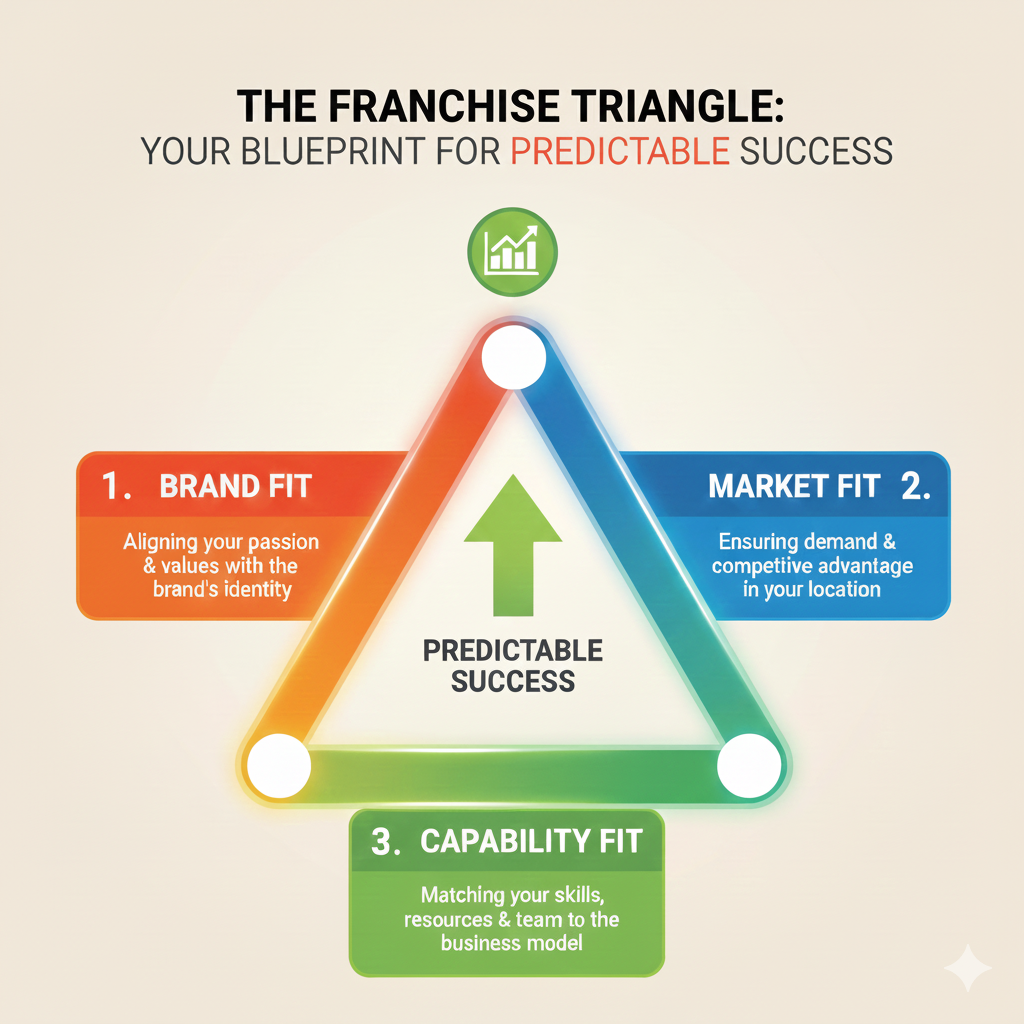
Let’s break each side down.
1. Brand Fit — Does This Brand Make Sense for Your Geography?
Brand Fit is not about whether the brand is famous.
It is about whether the brand is compatible with your customer base, your city, and your price point.
A franchise that thrives in Mumbai may not necessarily work in Madurai. A brand that explodes in Hyderabad may struggle in Ahmedabad. The brand’s product, positioning, and pricing must match the real behaviour of consumers in your area.
Here’s what strong Brand Fit looks like:
✔️ The brand already has proven success in similar markets
If you live in Trichy, look for brand case studies in cities like Salem, Coimbatore, Mysore—not New Delhi or Bangalore.
✔️ The pricing suits the spending capacity of your customers
If the brand’s average ticket size is ₹600 but your city prefers ₹200–₹300 meals, profitability becomes a challenge.
✔️ The concept is aligned with lifestyle trends in your region
For example:
- Vegan cafés thrive in metro cities, but not in many Tier 2 locations.
- Self-care and grooming franchises are booming everywhere—BUT the price point must match local expectations.
- Boutique fitness franchises thrive near IT parks but may struggle in purely residential pockets.
✔️ The brand solves a real problem in your area
Not all fancy brands solve real, local problems. Some categories are aspirational but not required.
Brand Fit is the first checkpoint.
If Brand Fit is weak, it doesn’t matter how strong the brand is nationally.
2. Market Fit — Is There Repeatable, Relevant Demand in Your Market?
A franchise does not survive on one-time customers.
It survives on repeat customers, local relevance, and consistent demand.
Many investors misunderstand footfall as demand.
Footfall ≠ relevant traffic.
Footfall ≠ conversion.
Footfall ≠ purchasing power.
Market Fit answers:
- Is there a stable and repeatable demand for this offering?
- Are there already successful players in this category?
- Does the market have the right demographic mix?
- Does the competition indicate strong demand or saturated demand?
A good market has:
- Purchasing power that matches the brand’s pricing
- Customer behaviour that supports the brand category
- A demographic base that fits the target audience
- Competition that is performing well (indicating category demand)
A poor market has:
- Low-income clusters for a premium brand
- High competition with weak unit economics
- Customer behaviour mismatched to the product
- Limited repeat consumption potential
Market Fit determines the true potential of your outlet.
Even a strong brand can fail in the wrong market.**
3. Capability Fit Does the Business Model Match You as an Operator?
This is the side of the triangle most investors ignore—and the side responsible for most failures.
Two individuals can invest in the same franchise, in the same market, with the same brand—and produce wildly different results. Why? Capability Fit.
Capability Fit answers:
- Does this business match your skill set?
- Does it match your management style?
- Does it match your availability and lifestyle?
- Does it match your tolerance for daily operations?
- Does it require people-management skills you may not have?
Some examples:
F&B Franchises
- Require daily involvement
- High manpower
- High wastage risk
- Tight operational control
Suitable for: hands-on owners who enjoy fast-paced work
Not suitable for: passive investors
Retail Franchises
- Require visual merchandising
- Strong inventory management
- Customer experience focus
Suitable for: organized, process-driven investors
Service-Based Franchises
- Require consistent quality
- People management
- Customer relationship building
Suitable for: investors with strong interpersonal skills
Skill-Based/Education Franchises
- Require parent communication
- Academic or training interest
Suitable for: investors interested in mentoring or education
Capability Fit is personal.
There is no “best franchise”—only the best fit for YOU.
Why Most Franchise Investors Choose Wrong (and How to Avoid It)
Most first-time franchise investors evaluate:
- Brand name
- Franchise fee
- Setup cost
- ROI promised
- Interior photos
- Brochure information
But they rarely evaluate:
- Their own operational capability
- Actual market behaviour
- Unit economics
- Local competition
- How the business will run in their absence
This leads to:
- Emotional decisions
- Mismatched expectations
- Operational stress
- Delayed breakeven
- Cashflow pressure
- Long-term frustration
The Franchise Triangle removes emotion from decision-making.
It replaces “hope” with clarity.**
How to Use the Franchise Triangle Before You Invest
✔️ Step 1: Brand Fit Checklist
- Does the brand have successful units in similar cities?
- Do customers in your city understand and value this offering?
- Is the pricing aligned with local purchasing power?
- Does the category already have demand?
✔️ Step 2: Market Fit Checklist
- What is the competition density?
- How are existing competitors performing?
- Is footfall relevant or irrelevant?
- What is the income, lifestyle, and age profile of the area?
- Is the space accessible, visible, and convenient?
✔️ Step 3: Capability Fit Checklist
- Do you have experience in a similar field?
- Do you enjoy daily operations or prefer passive oversight?
- Are you comfortable managing teams?
- Can you handle customer-facing environments?
- Does the business match your personality and energy?
If all three answers come out strong—you’ve found the right franchise.
Real Example: The Triangle in Action
Two investors approached the same café franchise.
Investor A:
- Strong people manager
- Loved F&B
- Opened next to a college
- Daily involvement
➡️ Became profitable within 10 months
Investor B:
- Wanted passive income
- Opened in a corporate area with low evening footfall
- Weak manager
➡️ Struggled, eventually exited
Same brand.
Same city.
Different triangle fit.
Conclusion: The Triangle Is the Foundation of Franchise Success
Choosing a franchise is not about excitement, trend, or gut feeling.
It is about clarity, alignment, and strategic thinking.
The Franchise Triangle ― Brand Fit, Market Fit, Capability Fit ― helps you eliminate 80% of mistakes before they happen. It is not a guarantee of success, but it is the closest thing to a scientific framework for making confident franchise decisions.
When all three align, the franchise becomes predictable.
When even one is weak, the franchise becomes stressful.
This single framework can protect your money, time, and peace of mind, and help you enter franchising with confidence and clarity.
Understand real-world costs: The Hidden Costs of Franchising – What Investors Never See Coming