
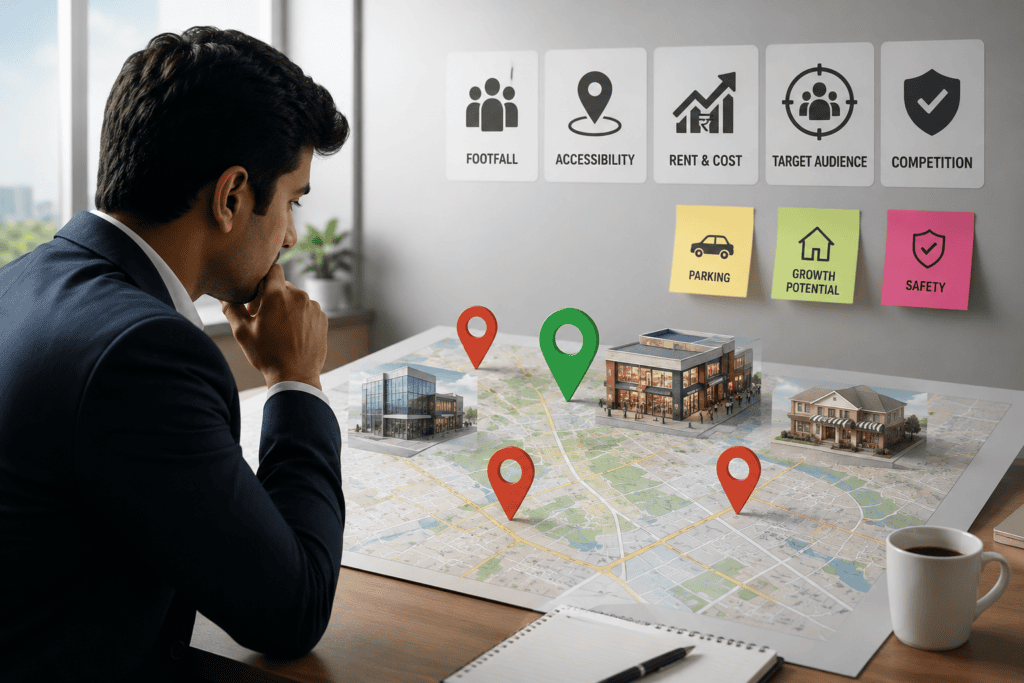
Ask any experienced operator what kills a franchise, and location sits at the top of the list — above the brand, the product, even the marketing. A strong brand in the wrong catchment struggles for years; an average brand on the right high street prints cash. Knowing how to choose the right franchise location in India is therefore the single highest-leverage decision a franchisee makes, because it locks in your footfall, your rent, and your ceiling on revenue before you sell a single unit.
This matters more in 2026 than ever. India’s retail real estate leasing reached a three-year high in 2025, and getting a prime site is now genuinely competitive. This guide breaks down the factors that decide a good location, a practical way to evaluate any site, and how the high-street, mall, and standalone formats compare. It’s written for the franchisee investor picking a single site and the brand planning a multi-city rollout. If you’re still at the starting line, first read our guide on how to start a franchise business in India.
Why Franchise Location Decides Success in India (2026)
Physical retail in India is expanding fast, and demand is concentrating in prime corridors. According to JLL, gross retail leasing across India’s top cities reached 12.5 million sq ft in 2025 — a 54% jump year on year — with high streets commanding a 48% share and shopping malls 45%. In other words, well-located high-street space is now in as much demand as malls. Leasing is also geographically concentrated: CBRE reports that Delhi-NCR, Chennai, and Bengaluru together absorbed over 75% of retail space in early 2026.
Three consequences follow for anyone choosing a franchise location:
- Prime sites are contested. International brand entries more than doubled year on year in the first half of 2025, so you are competing for the best corners against deep-pocketed operators.
- Consumption is healthy but selective. Indian retail sales grew about 10% year on year through late 2025 (Retailers Association of India), yet that spending clusters around convenience and experience — footfall follows the right micro-location, not just the right city.
- The winning approach is data-driven. Industry leaders now describe site selection as an evidence exercise built on brand-mix and consistent footfall, not instinct. That shift is exactly why a structured location process beats a gut-feel lease.
The takeaway: choosing a franchise location is no longer about finding available space — it’s about matching the right space to your brand’s customer and unit economics.
The Factors That Decide the Right Franchise Location in India
Every strong site is a stack of the following factors. Weakness in one can be survivable; weakness in three usually isn’t.
- Footfall — and footfall quality. Raw numbers matter, but so does whose feet. A thousand office workers rushing past suits a coffee format; a family-heavy weekend crowd suits a dessert or kidswear brand. Count footfall at different times and days before you believe a landlord’s claims.
- Catchment and demographics. Map the 1–3 km catchment around the site and check whether its income, age, and household profile match your brand’s target customer. A premium salon needs a different catchment than a value laundry.
- Visibility and accessibility. Frontage, signage rights, corner positions, and easy entry/exit convert passers-by into walk-ins. A site hidden on an upper floor or a hard-to-cross road leaks customers every day.
- Competition and co-tenancy. Nearby complementary brands and strong anchor tenants pull traffic to you; direct competitors saturating the catchment work against you. In malls especially, who you sit beside matters as much as the mall itself.
- Occupancy cost (the rent-to-sales test). This is where most franchises quietly fail. As a rule of thumb, base rent should stay within roughly 5–10% of forecast gross sales, and total occupancy cost (rent plus CAM, taxes, and maintenance) within about 6–12% — food and beverage formats ideally 7–9%. If the numbers only work at unrealistic sales, walk away.
- Format fit. A cloud kitchen wants cheap, delivery-friendly space, not a premium high street; a flagship wants visibility it can’t get in a basement. Match the format to the site, not the other way round.
- Regulations, parking, and last-mile. Signage restrictions, parking availability, licensing constraints, and delivery/loading access can quietly make or break daily operations — verify them before signing, not after.
High Street vs Mall vs Standalone: Which Format Fits?
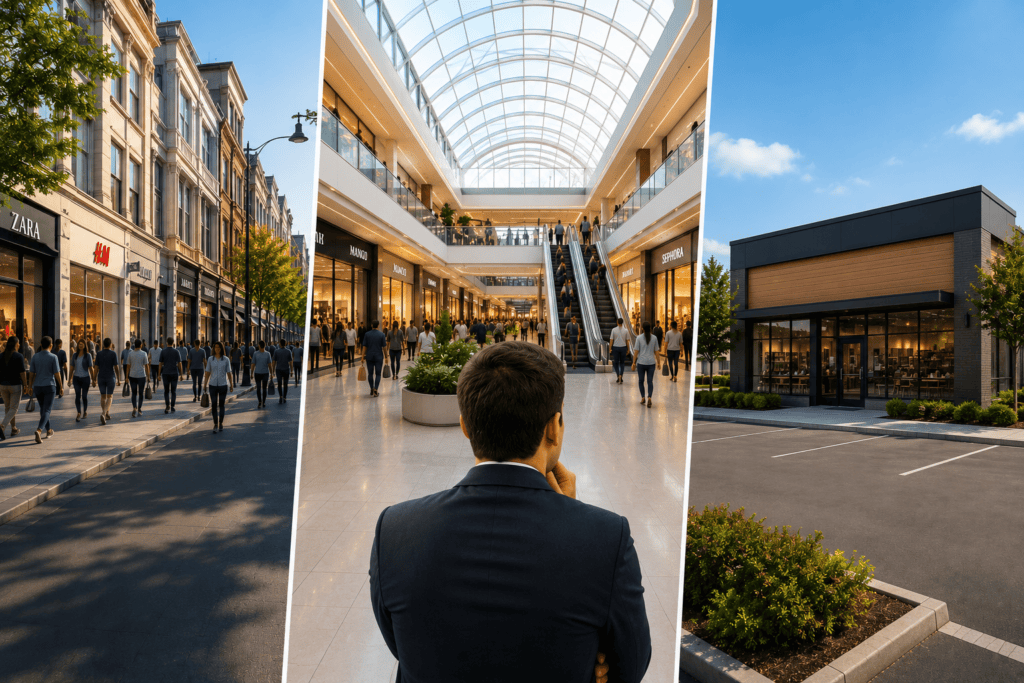
With high streets now leasing on par with malls, the format choice is genuinely open. Here’s how the three main options compare for a franchise in India.
| Factor | High Street | Shopping Mall | Standalone / Neighbourhood |
|---|---|---|---|
| Footfall type | Organic, local + passing trade | High, captive, weekend-heavy | Convenience-led, repeat-local |
| Rent & occupancy cost | Moderate–high, negotiable | High + CAM & revenue share | Lowest, most negotiable |
| Visibility & branding | Strong street frontage | Depends on floor/position | Variable, needs signage |
| Operating control | High (own hours, own rules) | Lower (mall timings, rules) | Highest |
| Best for | F&B, salons, apparel, services | Apparel, QSR, experiential brands | Groceries, pharmacy, services, cloud kitchens |
There is no universally “best” format — the right answer is whichever aligns your brand’s customer, margins, and operating model with the site’s cost and traffic.
How to Find the Right Franchise Location: A Step-by-Step Process
Turning those factors into a decision is a repeatable process, not a lucky find.
- Define your catchment and customer first. Write down exactly who your brand serves and the catchment profile that contains them. This filters out most sites before you ever visit.
- Study footfall and competition on the ground. Physically count footfall at peak and off-peak times, and map every competitor and complementary brand within the catchment. Pair this with available demographic and traffic data — the rigorous, analytical version of this is covered in our deep-dive on the science behind choosing a winning site.
- Run the rent-to-sales math before you fall in love. Forecast realistic monthly sales for the site, then test whether occupancy cost stays inside the 5–10% base-rent guideline. This one calculation prevents the most common — and expensive — hidden costs of franchising.
- Validate before you commit. Where possible, pilot demand — weekend counts, a kiosk test, or a short trial — rather than betting the full fit-out on assumptions.
- Negotiate the lease like it’s part of the ROI. Term length, rent escalation clauses, exclusivity, lock-in, and exit terms materially change your returns. A great site on a bad lease is still a bad deal.
Metro vs Tier 2 and Tier 3 Cities
Not every winning location is in a metro. Tier 2 and Tier 3 markets have sustained strong retail momentum, and setup and rental costs there can run materially lower than in the top seven cities — often with thinner competition and faster payback. The trade-off is smaller catchments and shallower footfall data, which makes disciplined, on-the-ground validation even more important. For many franchise formats in 2026, a well-chosen Tier 2 high street beats an over-priced metro mall unit.
Turn location guesswork into a data-backed decision
Picking the wrong site is the most expensive mistake in franchising — and the hardest to reverse. Our Franchise Location Strategy service maps catchments, models footfall and occupancy cost, and shortlists sites that actually fit your brand and budget. ➡️ Explore Franchise Location Strategy
Common Franchise Location Mistakes to Avoid
The recurring errors are predictable: chasing the cheapest rent instead of the best rent-to-sales ratio; copying a competitor’s location without checking catchment fit; trusting a landlord’s footfall claims without counting; ignoring signage, parking, or access constraints; and signing a rigid lease with no exit. Each looks small on day one and compounds every month afterwards.
Frequently Asked Questions (FAQ)
What is the most important factor in choosing a franchise location in India?
There is no single factor, but the rent-to-sales ratio is the one that most often decides profitability. A site with great footfall can still fail if occupancy cost is too high relative to realistic sales, so match location quality to affordable rent.
How much rent should a franchise pay?
As a general benchmark, base rent should stay within roughly 5–10% of forecast gross sales, and total occupancy cost (including CAM, taxes, and maintenance) within about 6–12%. Food and beverage formats ideally target 7–9%.
High street or mall — which is better for a franchise in India?
It depends on your format. High streets offer strong frontage, local footfall, and more operating control at moderate cost; malls offer high captive weekend footfall but higher rent, CAM, and revenue-share terms. In 2025, high streets and malls leased at nearly the same volume, so both are viable when matched to the right brand.
Are Tier 2 and Tier 3 cities good franchise locations?
Often yes. These markets have sustained strong retail growth, with lower rents and thinner competition than metros, frequently leading to faster payback. The caveat is smaller catchments and less footfall data, so on-ground validation matters more.
How do I estimate footfall for a potential location?
Physically count people passing and entering nearby comparable stores at different times and days, cross-check with catchment demographics and any available traffic data, and never rely solely on a landlord’s numbers.
Should the franchisor or the franchisee choose the location?
Ideally both, together. The franchisor knows which site profiles work for the brand; the franchisee knows the local market. The strongest outcomes come from a shared, data-backed process rather than either side deciding alone.
Choose Location Like It’s the Whole Business — Because It Nearly Is
Getting the right franchise location in India is not about finding available space; it’s about matching the right catchment, format, and rent to your brand’s economics — then validating it before you sign. Do that well and you remove the single biggest risk in franchising before you ever open the doors. For the full picture beyond location, see our complete franchise guide for brands and investors in India.
Evaluating a specific brand before you lease?
Location viability is half of any franchise’s ROI — the brand’s unit economics are the other half. Our Brand Evaluation Partner service validates both, so you invest with evidence, not optimism. ➡️ Get a Brand Partnership Evaluation
One partner, from site to scale — for investors and brands
Corporate Culture is a franchise development company covering location strategy, funding, and digital growth — and, for brands rolling out a network, a Franchise Readiness Audit backed by real case studies across India and the International, GCC. ➡️ Book a free strategy call