
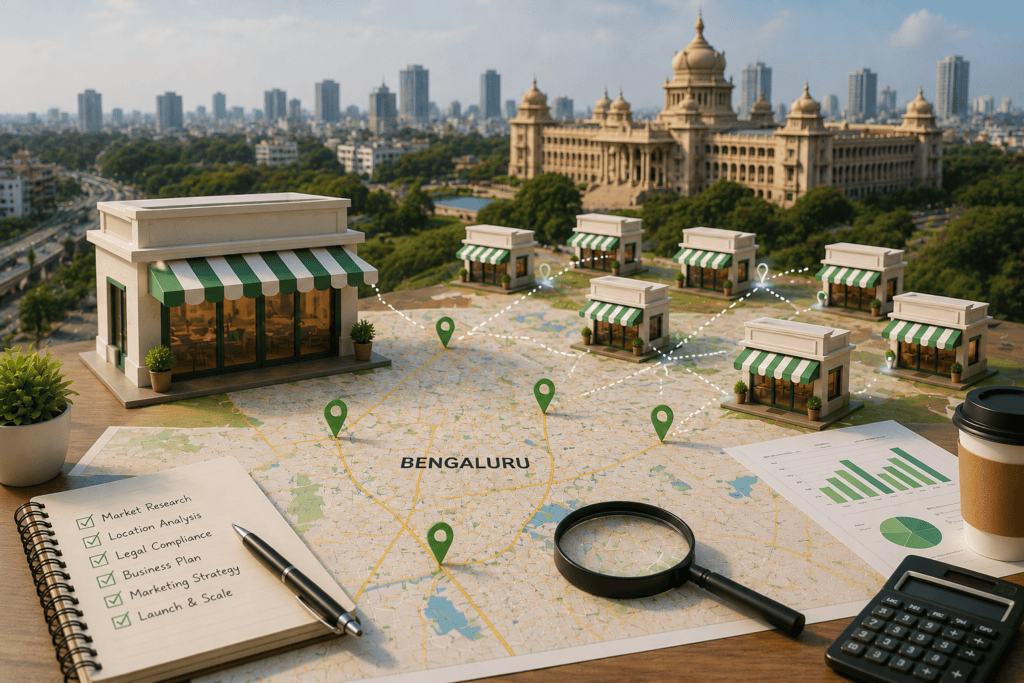
Bangalore — officially Bengaluru — has emerged as India’s fastest-growing franchise expansion market. A large, young, high-income technology workforce, a strong startup culture, and rapidly growing organised retail infrastructure combine to create a consumer base that is simultaneously experimental and brand-loyal. For brands willing to compete on data and digital presence rather than just brand recall, Bangalore offers some of the strongest growth potential of any Indian metro right now.
But Bangalore rewards a specific kind of discipline. Its investors are younger and more entrepreneurially minded than Mumbai’s or Delhi’s, its consumers research everything online before visiting, and instinct-led decisions here tend to lose to data-backed ones. Here’s how to work through the expansion process step by step.
Step 1: Understand What Makes Bangalore’s Market Different
Bangalore’s franchise investor profile stands apart from other metros:
- Typically younger and more entrepreneurially minded
- More comfortable with emerging categories than counterparts in Mumbai and Delhi
- Drawn to organised fitness, premium F&B, D2C brands entering retail, and wellness — categories fuelled directly by the city’s tech workforce’s purchasing power and lifestyle preferences
Consumer behaviour is equally distinct:
- Strong digital adoption — Bangalore consumers research brands extensively online before visiting a physical outlet
- A brand’s digital presence and online reputation directly drive footfall here, more than in most other metros
- A consumer base that’s experimental with new brands but becomes strongly loyal once trust is established
What this step actually means for you: if your brand’s digital presence is weak, fix that before you open a Bangalore outlet — it will suppress footfall regardless of how good your location or product is.
Step 2: Define Your Target Investor Profile
Bangalore investors respond to a different pitch than investors elsewhere. Before your first conversation, define:
- What capital range are you targeting, and does it match Bangalore’s typically younger, earlier-stage investor pool?
- How comfortable is your ideal investor with an emerging or less-established category, versus wanting a proven, familiar brand?
- Will this investor value data — unit economics models, market demand analysis, digital metrics — over brand heritage or prestige positioning?
What this step actually means for you: build your investor pitch around evidence and numbers first — Bangalore investors respond strongly to data, more than to brand story alone.
Step 3: Choose Your Corridor, Not Just “Bangalore”
Bangalore’s highest-value franchise corridors each have distinct consumer profiles and rental dynamics.
| Corridor | Character | Best for |
|---|---|---|
| Indiranagar | Established, high footfall, premium positioning | Premium F&B, wellness, speciality retail |
| Koramangala | Startup and young professional hub, experimental consumers | D2C brands entering physical retail, new-format concepts |
| HSR Layout | Residential-tech mix, family and young professional footfall | Organised fitness, wellness, family-oriented F&B |
| Whitefield | Tech-campus dense, corporate weekday footfall | Premium F&B and services targeting the tech workforce |
Each of these corridors responds differently to the same brand — a concept that thrives in Koramangala’s experimental, trend-forward crowd may need a more established, premium positioning to work in Indiranagar.
What this step actually means for you: match your brand’s positioning (established vs. experimental, premium vs. accessible) to the corridor’s character, not just its footfall numbers.
Step 4: Recalibrate Unit Economics — and Build the Data Model Investors Expect
[Insert chart here on publish: comparison of Bangalore’s four key corridors on relative footfall and rent premium, or a chart showing digital discovery’s share of footfall versus other metros.]
Bangalore investors respond strongly to data — more than in most other metros. Your unit economics model needs to go further here than a standard rent-and-revenue projection:
- Build a market demand analysis specific to your shortlisted corridor
- Include digital presence metrics as part of your projection — search visibility and social following are leading indicators of footfall in this market
- Present unit economics with the same analytical rigour a Bangalore investor would apply to any other financial decision
What this step actually means for you: a Bangalore investor pitch without a data-backed model will struggle here more than it would in a market where brand story carries more weight.
Step 5: Build a Complete, Evidence-First Investor Package
Before approaching a serious Bangalore investor, have ready:
- Unit economics model with supporting market demand data
- Digital presence metrics — search visibility, social following, online reputation
- SOP documentation
- A clear franchise agreement
- A defined territory plan, specific to the corridor you’ve shortlisted
What this step actually means for you: lead with data in your investor package — a Bangalore investor is more likely to be won over by a rigorous model than by brand prestige alone.
Step 6: Qualify Investors for Category Comfort, Not Just Capital
Bangalore’s investor pool is more comfortable with emerging categories than other metros, which is an advantage — but it also means you need to screen for genuine understanding, not just enthusiasm:
- Does this investor understand the operational demands of your specific category, especially if it’s a newer or less-established concept?
- Are they comfortable with the market-testing period an emerging category may need in this city?
- Do they have a realistic view of how quickly digital-driven footfall builds, versus expecting instant results?
What this step actually means for you: Bangalore’s openness to new categories can attract eager investors — make sure eagerness is backed by realistic expectations.
Step 7: Launch With Digital Visibility as the Primary Channel
This step matters more in Bangalore than in almost any other Indian metro. Bangalore consumers research brands extensively online before ever visiting — a launch without strong digital presence will underperform regardless of location quality. Before opening day:
- Local SEO built around your specific corridor (Indiranagar, Koramangala, HSR Layout, or Whitefield)
- A fully optimised Google Business Profile, live before launch
- An active social media presence establishing the brand’s identity before the first customer walks in
- A review management process ready from day one, since early reviews shape Bangalore’s trust-building consumer behaviour
What this step actually means for you: treat digital presence as your primary launch channel in Bangalore, not a supporting one.
Step 8: Scale on Proven Corridors, Not Just Proven Cities
Once your first Bangalore outlet is validated, expand to the next corridor deliberately — a strong Koramangala performance doesn’t guarantee the same result in HSR Layout, since the consumer psychology and positioning needs differ by corridor. Re-run Steps 3 through 6 for every new location.
What this step actually means for you: each new Bangalore corridor is a fresh positioning decision, even within the same city.
Frequently Asked Questions
Bangalore or Bengaluru — which name should I use for my franchise?
Both are understood and used interchangeably in business contexts; “Bengaluru” is the official name, while “Bangalore” remains widely used in commercial and investor-facing communication. Use whichever resonates with your target investor and consumer audience — many brands use both across different content.
What makes a franchise succeed in Bangalore specifically?
Bangalore’s franchise success factors are driven by its technology workforce demographic. Brands that perform well combine premium product quality with strong digital presence, efficient service formats, and clear differentiation from established competitors. The city’s consumer base is experimental but becomes brand-loyal once trust is established.
Which Bangalore corridor is best for a new franchise outlet?
It depends on your brand’s positioning. Indiranagar suits premium, established concepts. Koramangala favours experimental, trend-forward formats and D2C brands entering retail. HSR Layout works well for organised fitness and family-oriented F&B. Whitefield suits brands targeting the tech-campus corporate crowd.
How important is digital presence for a Bangalore franchise launch?
More important than in most other metros. Bangalore consumers research brands extensively online before visiting, so search visibility, Google Business Profile optimisation, and social presence directly affect footfall — sometimes more than the physical location itself.
Are Bangalore investors different from investors in other metros?
Yes. They tend to be younger, more entrepreneurially minded, and more comfortable with emerging categories than investors in Mumbai or Delhi. They also respond more strongly to data — unit economics models and digital metrics carry more weight here than brand heritage alone.
How Corporate Culture Can Help You Expand in Bangalore
Bangalore rewards brands that show up with evidence, not just enthusiasm. Corporate Culture works with franchise brands to build exactly that: data-backed investor packages, corridor-specific location strategy, digital-first launch planning, and unit economics models built to the analytical standard Bangalore’s investors expect.
We’ve supported structured franchise growth across categories — from Limelight Diamonds’ ₹20+ crore in franchise investments and 7-store rollout in 6 months, to Junior Kuppanna’s 20-outlet network built in 18 months — using the same disciplined, evidence-based approach in every engagement.
If you’re planning to expand into Bangalore, the right starting point is understanding exactly where your brand stands today — and whether your digital presence is ready to do the heavy lifting this market demands.
Speak directly with our team — book a free strategy call and we’ll walk you through exactly what your brand needs to succeed in Bangalore.