
Delhi NCR is India’s largest franchise market by geography and one of its most diverse by consumer profile. The National Capital Region spans Delhi, Gurgaon, Noida, Faridabad and Ghaziabad — and treating that as one market is the single most common mistake brands make when they expand here. Each zone has its own consumer demographics, rental dynamics and investor mindset, and a strategy built for one rarely transfers cleanly to another.
Get the zone-by-zone approach right, and NCR can support a genuinely large, resilient franchise network. Get it wrong, and you’ll find a strategy that worked brilliantly in Gurgaon quietly underperforming twenty kilometres away in East Delhi. Here’s how to work through the expansion process step by step.
Step 1: Understand That NCR Is Four Markets, Not One
Before anything else, unlearn the idea of “the Delhi market.” NCR investors and consumers vary sharply by zone:
- Gurgaon — corporate professionals with higher disposable incomes, evaluating premium franchise opportunities with real analytical rigour
- South Delhi — strongly aspirational at the premium end, with high expectations around brand positioning
- Noida — a mix of corporate and residential demand, generally more value-conscious at the mass-market level
- East Delhi and Faridabad — more conservative investors and consumers, with stronger price sensitivity
Consumer behaviour across the region skews toward value-consciousness at the mass-market level and strong aspirationalism at the premium end — often within a few kilometres of each other. Categories that consistently perform well across most of NCR:
- QSR and casual dining
- Education franchises
- Wellness brands, with premium fitness showing particularly strong growth in Gurgaon and South Delhi
What this step actually means for you: decide which specific zone you’re entering first — not “Delhi” — because your investor pitch, pricing, and location shortlist will all differ by zone.
Step 2: Define Your Target Investor Profile, By Zone
NCR franchise investors tend to be more conservative than Mumbai investors overall, with a stronger focus on brand heritage, territory exclusivity, and the franchisor’s existing network before committing. But this varies meaningfully within the region:
- Gurgaon investors are typically corporate professionals evaluating opportunities the way they’d assess any financial investment
- South Delhi and Central Delhi investors lean toward established, heritage-conscious brands
- Noida, East Delhi and Faridabad investors are often first-time or early-stage franchise owners who need more guidance and support
What this step actually means for you: write down which zone-specific investor profile you’re targeting for your first NCR outlet — a pitch built for a Gurgaon corporate investor will land differently with a first-time Faridabad owner.
Step 3: Choose Your Zone and Corridor, Not Just “Delhi”
This is the step that decides more of your NCR outcome than any other.
| Corridor | Areas | Rent-to-revenue risk | Footfall type | Best for |
|---|---|---|---|---|
| Premium high street | South Extension, Connaught Place, Khan Market | Highest in NCR | Aspirational, brand-conscious | Established brands who can absorb premium rent |
| Corporate corridor | Cyber City, Golf Course Road, MG Road (Gurgaon) | Moderate–high | Strong weekday footfall from professionals | F&B and wellness targeting working professionals |
| Emerging residential/mixed | Noida sectors, East Delhi | Lower, more negotiable | Value-conscious, steady local | First-time metro investors, mass-market formats |
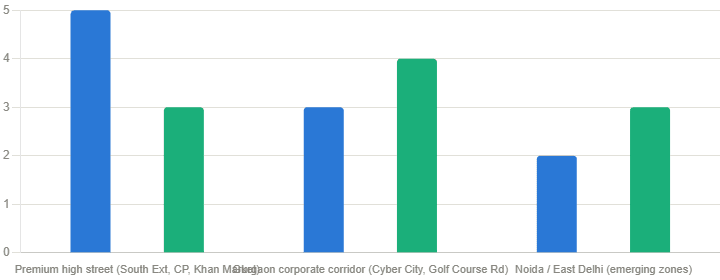
Premium high street corridors — South Extension, Connaught Place and Khan Market are aspirational addresses, but they carry the highest rent-to-revenue risk in the entire NCR market. These suit brands with strong existing recognition that can justify the premium.
Gurgaon’s corporate corridor — Cyber City, Golf Course Road and MG Road consistently deliver strong weekday footfall for F&B and wellness brands targeting working professionals, with somewhat more predictable unit economics than premium high streets.
Emerging zones — Noida and East Delhi offer lower rental pressure and a more value-conscious consumer base, making them a sensible entry point for first-time NCR investors or mass-market formats.
What this step actually means for you: pick one zone and corridor type that matches your brand’s price point and positioning — don’t let a single “Delhi” strategy try to cover Khan Market and East Delhi with the same model.
Step 4: Recalibrate Unit Economics for Each Zone
NCR’s biggest unit-economics trap isn’t just that costs are higher than Tier 2 cities — it’s that costs vary dramatically within the region itself. A Khan Market rent structure and a Noida sector rent structure are not remotely comparable, even though both sit under the same “Delhi NCR” label.
Build your model zone-specific from the start:
- Model rent, staffing and realistic revenue ramp separately for each shortlisted corridor
- Treat premium high street corridors as a higher-risk, higher-reward calculation, not a default first choice
- Present numbers honestly — NCR investors, particularly in Gurgaon, will test your projections against their own market knowledge
What this step actually means for you: don’t reuse one NCR-wide financial model across zones — rebuild it for the specific corridor you’ve shortlisted in Step 3.
Step 5: Build a Complete, Zone-Specific Investor Package
Before approaching a serious NCR investor, have ready:
- Unit economics model specific to their target zone and corridor
- SOP documentation
- A clear franchise agreement
- A defined territory plan — specific zones or postal codes, not just “Delhi NCR”
- Investor pitch materials calibrated to that zone’s investor profile (corporate-analytical for Gurgaon, heritage-focused for South Delhi, guidance-heavy for first-time owners in Noida or Faridabad)
Territory definition matters especially here because NCR’s sprawl makes vague boundaries easy to draw and expensive to dispute later — a franchisee in Gurgaon and one in South Delhi may both reasonably believe a new outlet in Noida encroaches on their exclusivity if the original agreement wasn’t precise.
What this step actually means for you: don’t reuse the same generic investor deck across all five NCR sub-markets — tailor it to the zone and investor type you’re approaching.
Step 6: Qualify Investors for Zone Fit, Not Just Capital
A financially capable investor in the wrong zone, or with the wrong operational expectations for that zone, can still produce an underperforming outlet. Screen for:
- Does this investor understand the specific zone’s consumer behaviour — value-conscious mass market versus premium aspirational?
- Do they have realistic expectations about footfall and ramp-up time for that corridor type?
- Are they prepared for the level of franchisor support typical for their zone’s investor profile (more hand-holding for first-time Noida/Faridabad owners, more analytical rigour expected by Gurgaon investors)?
What this step actually means for you: match the investor’s experience level and expectations to the zone, not just to your brand generally.
Step 7: Launch With Digital Visibility Built to the Zone
NCR consumers research brands online before visiting, but what they’re searching for varies by zone — a Gurgaon professional searching for a wellness brand near Cyber City has different intent than a Noida resident searching for a family QSR option. Build this in before launch:
- Local SEO targeting the specific corridor and neighbourhood, not “Delhi” broadly
- Google Business Profile optimised and live before opening
- Social content and messaging calibrated to that zone’s consumer profile
- Review management active from day one
What this step actually means for you: don’t run one generic “Delhi NCR” digital launch campaign — tailor messaging to the specific zone’s consumer, the same way you tailored your investor pitch.
Step 8: Scale Zone by Zone, Not All at Once
Once your first NCR outlet is validated, expand deliberately into adjacent zones rather than opening across multiple corridors simultaneously. A strong Gurgaon performance doesn’t predict South Delhi performance, and a working Noida model won’t automatically transfer to Faridabad. Re-run Steps 3 through 6 for every new zone you enter.
What this step actually means for you: treat each new NCR zone as a fresh expansion decision, not an extension of your first success.
Frequently Asked Questions
Is Delhi NCR one franchise market or several?
Effectively several. Delhi, Gurgaon, Noida, Faridabad and Ghaziabad each have distinct consumer demographics, rental dynamics and investor profiles. A single “Delhi” strategy typically underperforms a zone-by-zone approach.
Which part of Delhi NCR is best for a first franchise outlet?
It depends on your brand and risk appetite. Premium high street corridors like Khan Market or Connaught Place offer aspirational positioning but the highest rent-to-revenue risk in the region. Gurgaon’s corporate corridor offers strong, predictable weekday footfall for F&B and wellness. Noida and East Delhi offer lower rental pressure and a more value-conscious market — often the more sensible entry point for a first-time NCR investor.
How much does it cost to expand a franchise in Delhi NCR?
Costs vary significantly by zone. A premium high street location in South Delhi or Central Delhi commands substantially higher investment than a comparable outlet in Noida or East Delhi. Model costs specific to your shortlisted corridor rather than assuming one NCR-wide figure.
What kind of investor should I expect in Delhi NCR?
It depends on the zone. Gurgaon investors tend to be corporate professionals who evaluate opportunities with strong analytical rigour. South Delhi investors often favour brand heritage and territory exclusivity. Investors in Noida, East Delhi and Faridabad are more often first-time franchise owners who expect more guidance and hands-on support.
Should I expand into multiple NCR zones at once?
Generally no. A structured, one-zone-at-a-time approach lets you validate your model and refine your investor package before committing to a new zone with different consumer dynamics — reducing the risk of a struggling outlet damaging your brand’s reputation across the whole region.
How Corporate Culture Can Help You Expand in Delhi NCR
NCR rewards brands that treat it as five distinct markets rather than one. Corporate Culture works with franchise brands to build exactly that zone-by-zone approach — defining the right investor profile per corridor, shortlisting locations with structured evaluation criteria, recalibrating unit economics for each zone’s real cost structure, and building investor packages calibrated to the audience you’re actually pitching.
We’ve supported structured franchise growth across categories — from Limelight Diamonds’ ₹20+ crore in franchise investments and 7-store rollout in 6 months, to Junior Kuppanna’s 20-outlet network built in 18 months — using the same disciplined, evidence-based approach in every engagement.
If you’re planning to expand into Delhi NCR, the right starting point is understanding exactly where your brand stands today, and which zone genuinely fits it first.
Speak directly with our team — book a free strategy call and we’ll walk you through exactly what your brand needs to succeed across Delhi NCR.