
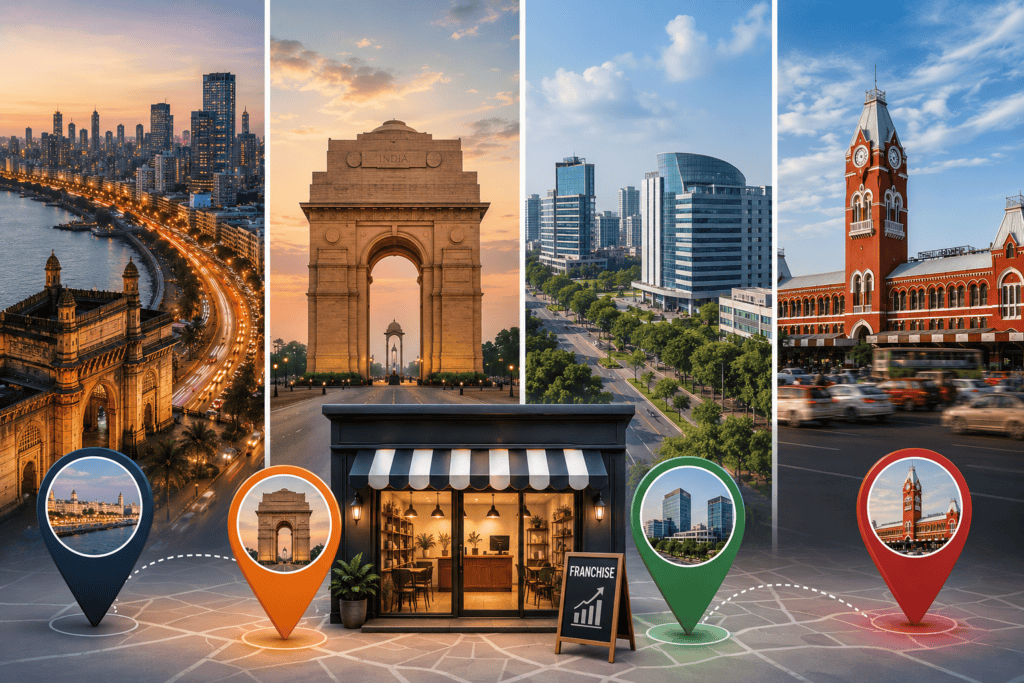
Mumbai, Delhi, Bangalore and Chennai account for a disproportionate share of India’s organised retail spending and serious franchise investor activity — making them the logical next step for brands with proven models and expansion ambitions. But metro expansion is fundamentally different from expanding in smaller markets: the stakes are higher, the competition is stronger, and the investors are more demanding. Brands that enter without the right structure consistently underperform — not because their product is wrong, but because their expansion approach is.
Successful metro franchise expansion comes down to six interconnected elements. Get these right, and you outperform brands that focus on one or two.
The Six Elements of a Metro Franchise Expansion Strategy
1. Territory Planning — Define Before You Sell
Metro territory planning is more complex than in smaller markets. Each city has multiple distinct micro-markets with different consumer demographics, rental costs and investor profiles — and the boundaries you set for your first franchise investor define the entire city’s expansion potential for years. Specify neighbourhoods, postal codes or zones clearly, not just the city name. Vague definitions lead to franchisee conflicts, catchment cannibalisation and long-term damage to investor relationships.
Explore our Franchise Location Strategy service →
2. Unit Economics — Recalibrate for Metro Costs
Your existing unit economics model needs explicit recalibration for each city. Rental costs typically run 30–50% higher than Tier 2 markets and vary significantly between micro-markets within the same city. Staff costs and attrition are also higher. Present metro-specific numbers honestly — investors will test your projections against their own market knowledge, and optimistic figures that don’t survive scrutiny destroy confidence faster than conservative ones.
3. Location Strategy — Data Over Instinct
In metro markets, location determines outlet performance more than almost any other factor. Use structured evaluation criteria — footfall count, catchment demographic match, competition density, access and visibility — rather than relying on franchisee instinct or landlord claims. Our work with Limelight Diamonds is a clear example of what structured, data-backed expansion delivers: ₹20+ crore in franchise investments facilitated and 7 luxury retail stores launched within 6 months, by qualifying serious investors and validating each site before commitment rather than chasing visibility alone.
How to Choose the Right Franchise Location in India
4. Investor Qualification — Metro Investors Are Different
Metro investors typically have prior business experience, access to capital, sharper questions about franchisor support and SOP documentation, and multiple opportunities under evaluation simultaneously. Have your complete investor package — unit economics, SOPs, franchise agreement, territory plan — ready before the first conversation. Metro investors who receive incomplete documentation rarely give second chances.
5. Brand Positioning — Stand Out in Saturated Markets
Metro consumers have exposure to hundreds of franchise brands across every category. Standing out requires sharp category differentiation, strong digital presence (metro consumers research extensively online before visiting), and absolute operational consistency across every outlet.
6. Franchisor Support — Metro Investors Expect More
Metro investors commit significantly more capital to higher-risk locations and need confidence the franchisor will stay responsive. Define your support framework explicitly — field visit frequency, marketing support, supply chain reliability, and escalation process — before entering metro markets.
Understanding Each Metro Market
Each city has distinct consumer behaviour, investor profiles and franchise dynamics. Treating them as one homogeneous market is one of the most common — and costly — mistakes brands make.
Mumbai — High Visibility, High Stakes
Mumbai is India’s most competitive franchise market, with the country’s highest concentration of premium retail locations and its most financially sophisticated investors. Prime corridors like Bandra and Lower Parel command premium rents, while suburban areas such as Borivali and Mulund offer strong demand with lower rental pressure. Premium F&B, wellness, beauty and education perform strongly among Mumbai’s young, brand-aware consumer base.
→ Read our full guide: How to Expand Your Franchise in Mumbai
Delhi NCR — Scale and Diversity
Delhi NCR spans Delhi, Gurgaon, Noida, Faridabad and Ghaziabad — each a distinct market by consumer profile, rental cost and investor mindset. Gurgaon’s corporate corridor delivers strong weekday footfall for F&B and wellness brands, while South Delhi’s aspirational high streets carry the highest rent-to-revenue risk in the region. A zone-by-zone strategy is essential; a single “Delhi” approach doesn’t work.
→ Read our full guide: How to Expand Your Franchise in Delhi NCR
Bangalore — India’s Fastest-Growing Franchise Market
Driven by a large, young, high-income technology workforce, Bangalore offers a consumer base that is both experimental and brand-loyal. Indiranagar, Koramangala, HSR Layout and Whitefield are its highest-value corridors. Bangalore investors respond strongly to data — unit economics models and digital presence metrics carry more weight here than in other metros.
→ Read our full guide: How to Expand Your Franchise in Bangalore
Chennai — Brand Loyalty and Operational Discipline
Chennai investors are thorough and relationship-oriented, expecting strong franchisor support and documentation. Anna Nagar, T Nagar, Nungambakkam and OMR are the primary corridors, while emerging areas like Egmore and Perambur offer better unit economics for first-time metro investors. Regional consumer preferences — pricing, menu adaptation, language — matter more here than in other metros.
→ Read our full guide: How to Expand Your Franchise in Chennai
Common Mistakes Brands Make in Metro Expansion
- Entering without metro-specific unit economics — using the same financial model everywhere without adjusting for metro rental and staff costs.
- Choosing investors on capital availability alone — rather than operational fit and location access.
- Setting vague territory boundaries — creating disputes when expanding further in the same city.
- Underestimating digital presence requirements — launching in Bangalore or Mumbai without strong local SEO and Google Business Profile visibility.
- Scaling too fast within a city — opening multiple outlets before the first has proven sustainable performance.
Frequently Asked Questions
Which metro city should I expand my franchise into first?
It depends on where your brand has existing consumer awareness, strongest investor interest, and where your category has established demand. Brands from South India typically find Chennai or Bangalore the most natural first market; brands with national appeal often start with Mumbai or Delhi. The decision should be data-driven, not based on where the first enquiry came from.
How much does it cost to open a franchise in a metro city in India?
Total setup investment for a retail or F&B franchise in an Indian metro typically ranges from ₹25 lakhs to ₹2 crore, covering franchise fee, fit-out, equipment, inventory and working capital — varying significantly by category and micro-market.
How do I find serious franchise investors in metro cities?
Through structured investor networks, franchise exhibitions, targeted digital outreach, and referrals from existing franchisees. The quality of your investor package — unit economics, SOPs, brand standards, franchise agreement — determines the quality of investors you attract.
Is it better to start with a Tier 2 city before entering metros?
For most brands, yes. A proven, replicable model in a smaller market gives you the operational learning and investor reference points metro investors expect to see. Brands with strong existing presence and complete documentation can enter metros directly with the right preparation.
How important is territory exclusivity for metro franchise investors?
It’s one of the most important factors, particularly in Mumbai and Delhi where real estate costs are highest. Investors committing ₹50 lakhs to ₹2 crore need confidence the brand won’t open a competing outlet in their catchment during the exclusivity period.
Ready to Expand Your Franchise Into Metro Cities?
Metro franchise expansion done right is one of the highest-value growth moves a consumer brand can make. Done without the right structure, it creates expensive problems that set your metro presence back by years. The right preparation takes 60–90 days; the wrong approach can take years to fix.
Speak directly with our team — book a strategy call and we’ll walk you through exactly what your brand needs to succeed in Mumbai, Delhi, Bangalore or Chennai.